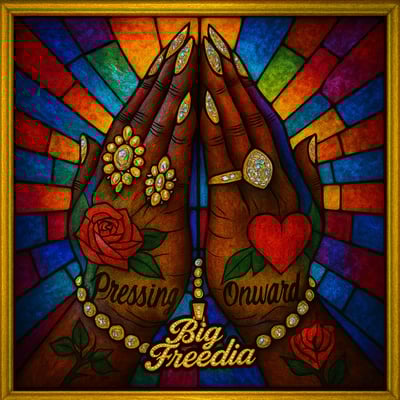
Big Freedia Pressing Onward
Released Aug 8, 2025 Queen Diva LLC
Consensus forming 3 professional reviews Updated Nov 25, 2025
Mostly positive consensus
Consensus is still forming across 3 professional reviews. Big Freedia's Pressing Onward stakes a vivid claim at the intersection of bounce and Southern gospel, where pew and party fold into the same ritual.
How ChoruScore worksCritics' Top Tracks
The songs critics returned to most
Take My Hand
3 critic mentions
“Both "Take My Hand" and "Never Forget" are full-on bangers with Freedia rapping over trap-like beats” — Glide Magazine
Pew
2 critic mentions
“the climactic penultimate track “Pew,” which borrows from funk, disco, and gospel in equal measure” — Pitchfork
Sunday Best (feat. Tamar Braxton)
2 critic mentions
“Sunday Best" in particular is a fantastic coming together of materialism/spirituality” — Glide Magazine
Full critic consensus
Big Freedia's Pressing Onward stakes a vivid claim at the intersection of bounce and Southern gospel, where pew and party fold into the same ritual. Critics agree the record earns its moments when choir-stacked harmonies meet Freedia's brazen bounce: “Take My Hand”, “Revival” and the climactic “Pew” recur as the album's most compelling pieces, while collaborative turns like “Sunday Best (feat. Tamar Braxton)” and the stomping “Praise Dance” underline the project's communal energy. With a 70.33/100 consensus score across 3 professional reviews, reviewers cite both breakthrough inventiveness and occasional lapses into safer territory.
Across professional reviews critics consistently highlight themes of faith and secularism, inclusion and queer theology, and grief transformed into perseverance. Pitchfork praises the collision of preacherly call-and-response with cheeky bounce vocals and singles out “Highway To Heaven” for resolving initially dissonant elements into rhythmic payoff. Rolling Stone frames several tracks as eulogies turned celebrations, where songs like “Revival” and “Take My Hand” make gospel earnestness and twerking coexist. Glide Magazine notes the record remains rooted in Freedia's bounce identity even as gospel textures expand the sonic palette, while flagging a few fusion experiments such as “Let It Rain” as less convincing.
The critical consensus suggests Pressing Onward is a confident, sometimes uneven detour that broadens Big Freedia's terrain—essential listening for those curious about gospel-bounce fusion and the best songs on the record, even as some tracks lean toward conventional warmth rather than the album's most daring impulses. Below follow the full reviews that map how community, grief, and church rhythms propel Freedia forward.
Track Ratings
How critics rated each track, relative to this album (0-100). Only tracks that made critics feel something are rated.
Revival
Take My Hand
Church
Let It Rain
Holy Shuffle (feat. Billy Porter)
All I Need
Highway To Heaven
Celebration (feat. Dawn Richard)
Sunday Best (feat. Tamar Braxton)
Queen's Testimony (feat. K. Michelle)
Never Forget
Praise Dance
Pew
Pressing Onward
Get the next albums worth your time.
Critic-backed picks in one clean digest. No clutter.
What Critics Are Saying
Deep insights from 4 critics who reviewed this album


Critic's Take
Combining bounce and Southern gospel, Big Freedia on Pressing Onward finds a brazen meeting point between the pew and the dancefloor, and the best songs - “Take My Hand”, “Let It Rain” and the climactic “Pew” - make that fusion feel inevitable. The reviewer's voice delights in the collision of preacherly call-and-response and cheeky bounce vocals, praising how choral harmonies amplify Freedia's vocal charisma while also noting when a track lapses into conventionality. Overall, the album is celebrated for carving new space in contemporary gospel with unabashed queerness and relentless energy.
Key Points
-
“Pew” is the album’s best track for its bold fusion of funk, disco, and gospel and its climactic placement.
-
The album’s core strengths are Freedia’s vocal charisma, inventive call-and-response arrangements, and the merging of bounce with gospel traditions.

Critic's Take
The review highlights that songs like “Take My Hand” and “Never Forget” are full-on bangers, while noting the fusion attempts on “Let It Rain” are less successful. Overall the critic pitches the album as a confident, gospel-saturated detour that never fully abandons Freedia’s bounce roots.
Key Points
-
The album’s core strength is its confident fusion of bounce and gospel, large choirs, and emotional grounding in church tradition.
Themes

Critic's Take
In her warm, streetwise phrasing Meagan Jordan hears the heart of Big Freedia beating through Pressing Onward, where the best songs - notably “Revival” and “Take My Hand” - mix gospel earnestness with bounce bravado. Jordan lingers on moments of inclusion and resilience, noting how “Church” insists that faith can be interior and how “Never Forget” makes you sing and twerk at once. The review reads as both eulogy and celebration, mapping grief onto joyful music that invites both worship and the dance floor.
Key Points
-
“Revival” is the best song because it frames the album’s emotional and musical mission with a bluesy choir and the repeated call to 'get up'.
-
The album’s core strengths are its fusion of gospel, bounce, blues, and dance, and its insistence on inclusion and resilience in the face of grief.