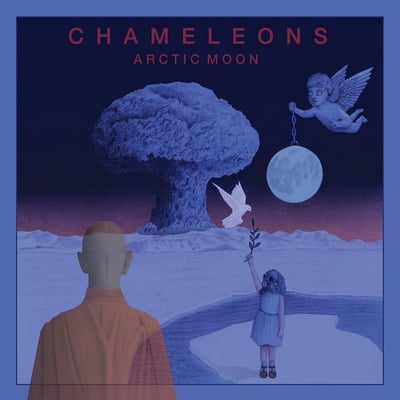
Chameleons Arctic Moon
Released Sep 12, 2025 Metropolis Records
Early read 2 professional reviews Updated Nov 23, 2025
Broadly positive consensus
Early read based on 2 professional reviews. Chameleons's Arctic Moon arrives as a defiantly emotional comeback, a record that marries revivalist ambition with the band's familiar melancholic pulse.
How ChoruScore worksCritics' Top Tracks
The songs critics returned to most
Where Are You?
2 critic mentions
“I need someone who’s not afraid/Of this dark dynamic we have made” — Louder Than War
David Bowie Takes My Hand
2 critic mentions
“Which leads into "David Bowie Takes My Hand", a loving tribute to David Bowie” — The Spill Magazine
Saviours Are a Dangerous Thing
2 critic mentions
“All the monkeys part to let him pass/He thinks he’s Jesus riding on an ass” — Louder Than War
Full critic consensus
Chameleons's Arctic Moon arrives as a defiantly emotional comeback, a record that marries revivalist ambition with the band's familiar melancholic pulse. Critics agree the album's emotional nucleus is front-loaded - “Where Are You?” earns near-universal praise as a brilliant opener - while longer pieces such as “David Bowie Takes My Hand” underline the collection's tribute and reflective impulses. With an 80/100 consensus score across two professional reviews, the critical consensus frames Arctic Moon as a renewed, confident statement rather than a mere nostalgia trip.
Reviewers consistently highlight melody and emotional honesty as the record's strengths, noting songs that balance chiming guitars and muscular riffs with spiritual skepticism and existential dread. “Saviours Are a Dangerous Thing”, “Magnolia”, and “Lady Strange” recur in reviews as standout tracks, each illustrating different facets of the album - from taut, vulnerable lyricism to sparse, bass-forward lament. Critics praised the band for channeling tainted love and renewal/rebirth themes into arrangements that feel three-dimensional and often cinematic.
While both reviews are celebratory, they also emphasize craft over sentiment: the album's slow builds and biting tributes keep it from feeling indulgent. The consensus suggests Arctic Moon is not only worth listening to but represents a high point in the Chameleons' catalog, a record that rewards repeated plays and close attention to its layered melodies and mournful, resilient spirit.
Track Ratings
How critics rated each track, relative to this album (0-100). Only tracks that made critics feel something are rated.
Where Are You?
Lady Strange
Feels Like The End Of The World
Free Me
Magnolia
David Bowie Takes My Hand
Saviours Are a Dangerous Thing
Get the next albums worth your time.
Critic-backed picks in one clean digest. No clutter.
What Critics Are Saying
Deep insights from 3 critics who reviewed this album


Critic's Take
Chameleons return triumphantly on Arctic Moon, and the best songs on the record - notably “Where Are You?” and “Saviours Are A Dangerous Thing” - feel like the emotional center of a long-awaited comeback. Side two is described as the album's grounding, with “Magnolia” and “David Bowie Takes My Hand” singled out for their slow build and heartfelt tribute, reinforcing why listeners ask what the best songs on Arctic Moon are. The narrative stays rooted in fandom and admiration, insisting this is the Chameleons' best album to date.
Key Points
-
The best song is the opener "Where Are You?" because the reviewer calls it brilliant and quintessentially Chameleons.
-
The album's core strengths are strong melodies, emotional honesty, and well-sequenced side two anchored by tributes and slow-building songs.
Themes

Critic's Take
Chameleons sound revitalised on Arctic Moon, and the best songs - notably “Where Are You?” and the eight-and-a-half-minute “David Bowie Takes My Hand” - show why. The reviewer's voice finds them more three-dimensional, balancing chiming guitars with deep melancholy, so the best tracks on Arctic Moon are those that marry muscular riffs to bittersweet lyricism. “Free Me” and “Magnolia” are singled out as standout moments, one a near stadium ballad and the other a sparse, bass-heavy lament. Overall, the record stakes a convincing claim as possibly their best album yet while retaining the band's signature wounded grandeur.
Key Points
-
The best song is the epic “David Bowie Takes My Hand” for its ambition and emotional ascent.
-
The album’s core strengths are mature songwriting, three-dimensional arrangements, and a bittersweet balance of melody and melancholy.