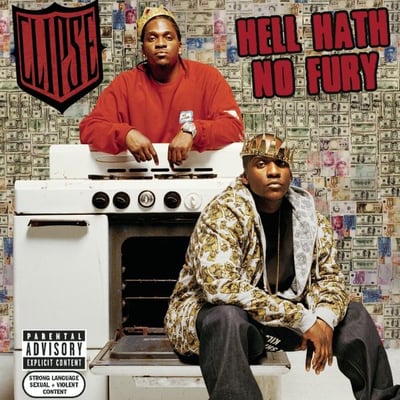
Clipse Hell Hath No Fury
Released Nov 28, 2006 Arista
Established consensus 24 professional reviews Updated Mar 23, 2026
Strong critical consensus
Clipse's Hell Hath No Fury strikes like a clinical portrait of street life, where ascetic rage and designer-braggadocio coexist across terse, unforgiving beats.
How ChoruScore worksCritics' Top Tracks
The songs critics returned to most
Mr. Me Too
7 critic mentions
“the sniping slow burn of lead single "Mr. Me Too" wasn't enough notice” — Pitchfork
Ride Around Shining (feat. Ab-Liva)
6 critic mentions
“the tense harp plucks of "Ride", posed against clipped groans and a single straining high note, are both fractured and gorgeous.” — Pitchfork
Trill
5 critic mentions
“Trill" grinds and slides under a swarm of hungry cyborg mosquitoes.” — AllMusic
Full critic consensus
Clipse's Hell Hath No Fury strikes like a clinical portrait of street life, where ascetic rage and designer-braggadocio coexist across terse, unforgiving beats. Critics agree the record's power lies in narrow focus: sparse, sinister Neptunes production frames diary-like narratives of hustling, paranoia, and desperation, and the result feels like some of Pusha T and Malice's most matured, honest work.
Across 24 professional reviews the album earned an 84.5/100 consensus score, with reviewers consistently naming “Mr. Me Too”, “Momma I'm So Sorry” and “Trill” among the best songs on Hell Hath No Fury. Multiple critics praise how the Neptunes step back with minimal, grimey sonics so the duo's whip-smart, cocaine-rap lyrics cut through; tracks such as “We Got It for Cheap (Intro)” and “Ride Around Shining (feat. Ab-Liva)” also surface as standout moments in professional reviews. The recurring themes - fantasy versus reality, grim atmosphere, producer-artist synergy, and label limbo frustration - shape a record that feels both stylish and sinister.
While most reviews celebrate the album's consistency and inventive minimalism, some accounts note its bleakness and clinical distance, framing that austerity as either refinement or emotional withholding. Taken together the critic consensus suggests Hell Hath No Fury is a tightly wrought, essential entry in Clipse's catalog, one that rewards listeners seeking the best tracks on Hell Hath No Fury and a stark, uncompromising vision of the drug-game narrative. Read on for full reviews and track-by-track notes.
Track Ratings
How critics rated each track, relative to this album (0-100). Only tracks that made critics feel something are rated.
We Got It for Cheap (Intro)
Momma I'm So Sorry
Mr. Me Too
Wamp Wamp (What It Do) [feat. Slim Thug]
Ride Around Shining (feat. Ab-Liva)
Dirty Money
Hello New World
Keys Open Doors
Ain't Cha (feat. Re-Up Gang)
Trill
Chinese New Year
Nightmares (feat. Bilal & Pharrell Williams)
Get the next albums worth your time.
Critic-backed picks in one clean digest. No clutter.
What Critics Are Saying
Deep insights from 24 critics who reviewed this album

Critic's Take
Clipse sound bruised and meticulous on Hell Hath No Fury, and the best tracks - notably “Momma I'm So Sorry” and “Mr. Me Too” - capture that grim, forensic tone. Alexis Petridis writes with a clinical relish, celebrating how the Neptunes' stripped, one-finger synths and harsh trebly beats let the Thorntons' whip-smart lyrics cut through, so the best songs on Hell Hath No Fury are where production and prose align. He singles out “Momma I'm So Sorry” for its troubled chorus and “Mr. Me Too” for its blank-eyed female vocal and precise listing of designer names, making them the album's clearest standouts. The review frames these tracks as proof that deprivation and delay refined Clipse into something oddly heartening rather than merely nihilistic.
Key Points
-
Momma I'm So Sorry is best for its remorseful chorus and moral complication.
-
The album's core strength is its spare, bleak Neptunes production that foregrounds Clipse's precise, troubled lyricism.
Themes
Critic's Take
The reviewer's voice praises the duo’s matured honesty, from Malice’s confessionals on “Momma I’m So Sorry” to Pusha T’s vivid drug-game metaphors, making these the best tracks on Hell Hath No Fury.
Key Points
-
The production-forward tracks like "Keys Open Doors" best show Clipse’s lyrical and sonic brilliance.
-
The album’s core strengths are meticulous songwriting, inventive Neptunes production, and honest, matured storytelling.
Themes
Ob
En

Critic's Take
Me Too” - exemplify the record's lean, furious focus. The album's magnetically grim tone ties these standouts together, turning minimal production into maximal menace.
Key Points
-
The album's core strength is its sparse, off-kilter Neptunes production that accentuates Pusha T's and Malice's blunt-force rhymes and grim atmosphere.
Themes

Critic's Take
Clipse deliver on Hell Hath No Fury with a relentless focus that makes the best tracks unmistakable: “Mr. The reviewer revels in the Neptunes' cold, sinister sonics and spare, incisive lyrics, noting how those elements elevate the album and its standout moments. For listeners searching for the best songs on Hell Hath No Fury, the muscular production and Pusha T's maniacal intensity mark “Mr. Me Too” and “Trill” as essential listens. Overall the album's uncompromising tone and vivid storytelling make these tracks the clearest exemplars of its power.
Key Points
-
The best song is best because Neptunes production and Pusha T's intensity coalesce into a monstrous, unforgettable track.
-
The album's core strengths are spare incisive lyrics and sinister, adventurous Neptunes sonics creating uncompromising street music.
Themes

Critic's Take
Clipse return on Hell Hath No Fury with a relentless focus that makes the best tracks stand out, especially “Mr. Me Too” and “Trill”. The reviewer's voice applauds how the Neptunes finally step back and let the Clipse dominate, which is why “We Got It for Cheap (Intro)” and “Momma I’m So Sorry” register as vital moments. The album is praised for marrying filthy synths and steel drums to sharp, cocky raps, producing some of the best songs on Hell Hath No Fury. It is repeatedly framed as one of the year’s top rap releases, a potent combination of top-tier production and consistent, hungry lyricism.
Key Points
-
The best song is "Mr. Me Too" because it was the album's hit and showcases vicious, memorable verses.
-
The album’s core strengths are the Neptunes' focused production and the Clipse’s consistent, cocky lyricism.
Themes
Pr
Hi
Al
Co

Ir
Critic's Take
Clipse return on Hell Hath No Fury with the same claustrophobic, space-age Neptunes production that made their earlier work sing, and the best tracks - especially “Mr. Me Too” and “Nightmares (feat. Bilal & Pharrell Williams)” - crystallise Pusha T and Malice's uncompromising diary of street life. The reviewer's tone is admiring and precise, noting that Pharrell Williams and Chad Hugo deliver their best work since Lord Willin', which lifts the album's standout moments. There is no moralising here, only dark, stylish flourishes that make the best songs on Hell Hath No Fury linger long after the final beat.
Key Points
-
The album's core strength is its claustrophobic, space-age production paired with uncompromising street narratives.
Themes
Dr
Critic's Take
Clipse's Hell Hath No Fury is propelled by The Neptunes' pitch-perfect production and Pusha-T and Malice's vicious, witty rhymes, which makes songs like “We Got It for Cheap (Intro)” and “Mr. Me Too” immediate standouts. Will Dean writes with a wry, slightly incredulous voice - he admires the merger of murky crack-world subject matter with pop-level craft, and that tension is why listeners search for the best tracks on Hell Hath No Fury. The record drags you "kicking and screaming" into its pseudo-glamour, and that shovey opening plus the Pharrell-featured “Mr. Me Too” are singled out as highlights. Even when grumbling about the awful sleeve, Dean cannot deny this is one of the records of the year, which steers readers hunting for the best songs on Hell Hath No Fury straight to those moments.
Key Points
-
The opener “We Got It for Cheap (Intro)” is best for immediately immersing the listener in the album's world.
Themes

Critic's Take
Minimalist Neptunes production ties the record together, elevating songs such as “Trill” and “Mr. Me Too” into eerie, memorable highlights. Overall, the best songs on Hell Hath No Fury are those that balance inventive metaphors with uncanny production, delivering both amusement and a sting of authenticity.
Themes

Sp
Bi

