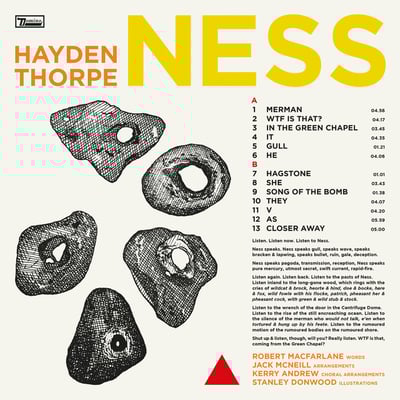
Hayden Thorpe Ness
Released Sep 27, 2024 Domino Recording Co
Consensus forming 3 professional reviews Updated Jan 1, 2026
Broadly positive consensus
Consensus is still forming across 3 professional reviews. Hayden Thorpe's Ness arrives as a cinematic, place-driven record that translates Robert Macfarlane's prose into a humid, uncanny soundworld.
How ChoruScore worksCritics' Top Tracks
The songs critics returned to most
Merman
2 critic mentions
“Opener 'Merman' is an immediate highlight” — Clash Music
She
3 critic mentions
“She' takes inspiration from nature's spores and transmits it through a soothing, sensual waltz” — Clash Music
Closer Away
1 critic mention
“Closer Away' a suitably goosebump-inducing finale” — Clash Music
Full critic consensus
Hayden Thorpe's Ness arrives as a cinematic, place-driven record that translates Robert Macfarlane's prose into a humid, uncanny soundworld. Across three professional reviews the consensus finds the collection compelling if occasionally mannered, with critics praising its sonic experimentation, choral and spoken-word textures, and the ways folk instrumentation collides with electronic detail to evoke a reclaimed coastal landscape.
Critics agree that Ness earned a largely positive critical reception, arriving at a 76/100 consensus score across three professional reviews. Reviewers consistently single out “Merman” and “She” as standout tracks, with “He” also frequently noted for its maximalist fusion of electronics, sackbut and spinet. Tinnitist highlights how production flourishes - seeds on a bass drum, thistles as shakers - let the place speak, while Clash praises “Merman” for its heartbeat bass and clarinet-driven claustrophobia. DIY praises the record's cinematic ambition and the duet “As”, but flags “Song Of The Bomb” as a lyrical misstep, illustrating a divide between literary intent and immediate melodic payoff.
The critical consensus frames Ness as a collaborative, experimental ode to Orford Ness: a work of landscape and memory where spoken-word, choral elements and literary adaptation shape much of its narrative weight. Some critics find that ambition yields moments of profound atmosphere and memorable hooks, while others note occasional melodrama that tempers accessibility. For readers seeking the best songs on Ness, start with “Merman”, “She” and “He”; for those curious about Thorpe's evolving palette, the album positions itself as a rewarding, if occasionally divisive, chapter in his catalog.
Track Ratings
How critics rated each track, relative to this album (0-100). Only tracks that made critics feel something are rated.
Merman
WTF Is That?
In The Green Chapel
It
Gull
He
Hagstone
She
Song Of The Bomb
They
V.
As
Closer Away
Get the next albums worth your time.
Critic-backed picks in one clean digest. No clutter.
What Critics Are Saying
Deep insights from 4 critics who reviewed this album
mu

Critic's Take
In his hushed, ceremonial voice Karl Blakesley frames Hayden Thorpe’s Ness as a grand, collaborative odyssey where the best tracks - “Merman”, “He” and “V.” - conjure the album’s magic. He praises “Merman” for its heartbeat bass and howling clarinet that set a claustrophobic, mythical tone, while “He” is hailed as the maximalist high point with electronics fused to sackbut and spinet. “V.” is singled out as an early contender for highlight, its siren-like opening and pulsating electronica culminating in Kerry Andrew’s spellbinding chorus. The narrative maintains the reviewer’s measured, descriptive cadence and keeps the focus on why these tracks are the standouts on Ness.
Key Points
-
«Merman» stands out for its immediate, mythical atmosphere and distinctive instrumentation.
-
The album's core strengths are its orchestral collaboration, pastoral themes, and fusion of folk, electronica and spoken-word.
Themes

Critic's Take
Hayden Thorpe's Ness feels like a careful cinematic essay, and the best tracks - notably “WTF Is That?” and “As” - are where that ambition pays off most clearly. Doyle hears Hayden delve into melodrama on “WTF Is That?”, and the duet with Kerry Andrew on “As” lets vocals tangle around a clarinet to great mesmeric effect. At the same time, “Song Of The Bomb” is singled out as a misstep, its titular delivery veering into cringe, which makes the record feel more literary than immediately listenable. The strongest moments are those that balance storytelling with hooky melody - examples being the familiarity of “He” and the dreamy melancholy of “She”.
Key Points
-
The best song(s) balance cinematic ambition with memorable hooks, especially “WTF Is That?” and “As”.
-
The album's strengths are its literary ambition, cinematic arrangements, and moments of melodic earworms despite uneven execution.
Themes

Critic's Take
Hayden Thorpe and Ness translate Robert Macfarlane's prose into a humid, uncanny soundworld where “She” feels sensual and libidinal while “Merman” offers a requiem-like uncanny counterpoint. Sterdan's piece luxuriates in the production details - seeds on a bass drum, thistles as shakers - to argue that the best tracks on Ness are those that let the place speak, notably “She” and “Merman”, because they embody the album's interplay of folk, experimental orchestra and elegant pop. The review frames the album as an ode to Orford Ness that is both intimate and expansive, praising the collaborative thread with Macfarlane and the record's tactile, inventive textures. Overall, the best songs on Ness are highlighted for how they summon landscape into music, making the album feel like a lived, re-wilded document rather than a mere soundtrack.
Key Points
-
The best song is a track that most vividly evokes Orford Ness; “She” is singled out for its sensual, libidinal power.
-
The album's core strengths are its literary collaboration, inventive production textures, and a blend of folk, orchestra and pop that summons landscape into sound.