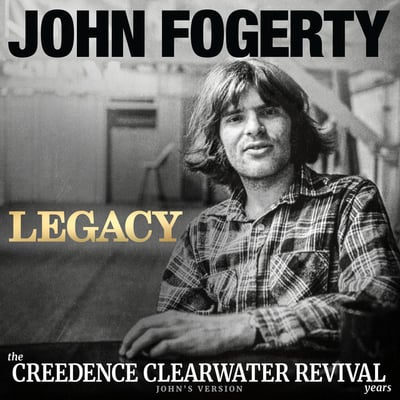
John Fogerty Legacy: the Creedence Clearwater Revival years
Released Aug 22, 2025 Concord Records
Consensus forming 3 professional reviews Updated Nov 25, 2025
Broadly positive consensus
Consensus is still forming across 3 professional reviews. John Fogerty's Legacy: the Creedence Clearwater Revival years arrives as a deliberate act of reclamation, a septuagenarian artist reasserting ownership over a catalog that helped define American rock.
How ChoruScore worksCritics' Top Tracks
The songs critics returned to most
Fortunate Son
1 critic mention
“its especially prescient on Fortunate Son” — Record Collector
Porterville
1 critic mention
“Porterville was tucked away on Side Two of Creedence ’s eponymous 1968 LP” — Record Collector
Born On The Bayou (John's Version)
1 critic mention
“In “Born on the Bayou”, John Fogerty’s growling drawl and grungy guitar chords splash the canvas” — PopMatters
Full critic consensus
John Fogerty's Legacy: the Creedence Clearwater Revival years arrives as a deliberate act of reclamation, a septuagenarian artist reasserting ownership over a catalog that helped define American rock. Across professional reviews, critics agree the record largely succeeds: Fogerty's voice retains a "powerfully soulful" grit, and reworkings such as “Up Around the Bend”, “Fortunate Son” and “Porterville” recapture the bracing immediacy and political bite that made the originals enduring.
The critical consensus, an 80/100 drawn from three professional reviews, frames the album as both faithful recreation and subtle reinvention. Reviewers consistently praise how tracks like “Born On The Bayou (John's Version)” and “Down On The Corner (John's Version)” preserve swamp-rock atmosphere while translating live intensity into studio clarity. Record Collector highlights “Porterville” as a rediscovered gem, PopMatters applauds the sustained fury of “Fortunate Son”, and Uncut notes vocal cues that anchor newer takes to the originals. Critics repeatedly emphasize the project's dual purpose: artistic restatement and legal reclamation of a historic catalogue.
Not all responses are unqualified. Some critics ask whether these versions surpass the pristine originals, pointing out that faithful revisitation can invite direct comparison. Still, reviewers agree Fogerty's vocal endurance and the record's careful arrangements make Legacy a meaningful document of legacy stewardship rather than a mere nostalgia exercise. For readers wondering whether Legacy is worth hearing, the consensus suggests it offers essential, often stirring perspectives on familiar songs while affirming why those songs remain vital.
Track Ratings
How critics rated each track, relative to this album (0-100). Only tracks that made critics feel something are rated.
Up Around The Bend (John's Version)
Who'll Stop The Rain (John's Version)
Proud Mary (John's Version)
Have You Ever Seen The Rain (John's Version)
Lookin' Out My Back Door (John's Version)
Born On The Bayou (John's Version)
Run Through The Jungle (John's Version)
Someday Never Comes (John's Version)
Porterville (John's Version)
Hey Tonight (John's Version)
Lodi (John's Version)
Wrote A Song For Everyone (John's Version)
Bootleg (John's Version)
Don't Look Now (John's Version)
Long As I Can See The Light (John's Version)
Down On The Corner (John's Version)
Bad Moon Rising (John's Version)
Travelin' Band (John's Version)
Green River (John's Version)
Fortunate Son (John's Version)
Get the next albums worth your time.
Critic-backed picks in one clean digest. No clutter.
What Critics Are Saying
Deep insights from 4 critics who reviewed this album

Critic's Take
The narrative frames these tracks as rightful heirs to the originals while noting the album's broader triumph: reclaiming ownership and reminding listeners why these songs mattered then and now.
Re
Critic's Take
Overall, the album reads as a lovingly mixed, fan-reassuring greatest-hits set that nonetheless finds room to sharpen older material.
Key Points
-
The album’s core strength is its forensic faithfulness to original arrangements combined with a surprisingly undiminished vocal power.
Themes

Critic's Take
Michael Bonner writes with a keen, slightly sardonic relish that John Fogerty has mostly vindicated himself on Legacy: the Creedence Clearwater Revival years. The tone is admiring but practical - Fogerty has reclaimed his songs and largely reproduces them with feral vigour, yet the reviewer questions why listeners would prefer these new versions to the pristine originals.
Key Points
-
Legacy's core strength is its meticulous, faithful recreation of CCR's originals and the enduring power of the songs.
Themes
