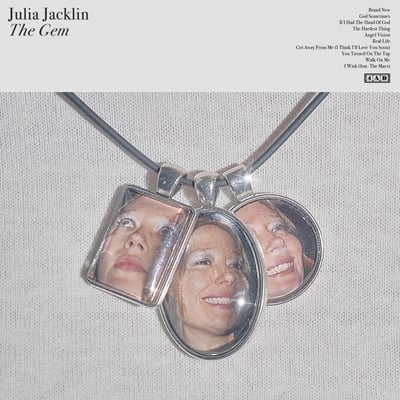
Julia Jacklin The Gem
Released Sep 25, 2026 4AD
Established consensus 11 professional reviews Updated Sep 30, 2026
Broadly positive consensus
Julia Jacklin's The Gem refines her bittersweet balladry into a more outward-facing, band-forward sound while keeping the intimate self-scrutiny that has defined her songwriting.
How ChoruScore worksCritics' Top Tracks
The songs critics returned to most
Get Away From Me (I Think I'll Love You Soon)
9 critic mentions
“The bright jangle of "Get Away from Me (I Think I’ll Love You Soon)" makes her fear of wanting someone to stay sound almost carefree,” — Slant Magazine
Brand New
8 critic mentions
“Brand New’ is an uncompromising opener, with its heavy-on-the-heart rhythm underpinning Jacklin’s raw vocals.” — Hot Press
Walk On Me
7 critic mentions
“The vocals are especially affecting on Walk On Me, which sounds as though it could be a cut from Crushing.” — The Guardian
Full critic consensus
Julia Jacklin's The Gem refines her bittersweet balladry into a more outward-facing, band-forward sound while keeping the intimate self-scrutiny that has defined her songwriting. Across 11 professional reviews the record earned a 77.73/100 consensus score, and critics consistently point to songs that balance wry observation with emotional urgency as the collection's clearest achievements.
Reviewers praise the album's standout tracks: “Get Away From Me (I Think I'll Love You Soon)”, “Brand New” and “Walk On Me” recur as the best songs on The Gem, lauded for their inventive arrangements, jangly 1980s-tinged guitar work and a knack for folding vulnerability into buoyant pop-rock. Critics note recurring themes of vulnerability, shame, survival and the push-pull between freedom and domestic intimacy, with harmonies and live-band warmth giving many moments a communal catharsis. Several reviews single out quieter, more reflective cuts such as “Angel Vision” and “God Sometimes” for their lullaby-like charm and spiritual overtones.
While most professional reviews are favorable, the consensus acknowledges a mild tension between refinement and daring: some critics celebrate the album's polished jangle and immediacy, others find it rarely upends expectation. Still, the prevailing critical consensus suggests The Gem succeeds as a creative reset that deepens Jacklin's emotional landscape without sacrificing melodic clarity. For readers wondering if The Gem is worth listening to, the record offers several immediate best tracks and enough nuance across its ten-song set to reward repeated plays.
Track Ratings
How critics rated each track, relative to this album (0-100). Only tracks that made critics feel something are rated.
Brand New
God Sometimes
If I Had The Hand Of God
The Hardest Thing
Angel Vision
Real Life
Get Away From Me (I Think I'll Love You Soon)
You Turned On The Tap
Walk On Me
I Wish (feat. The Maes)
Get the next albums worth your time.
Critic-backed picks in one clean digest. No clutter.
What Critics Are Saying
Deep insights from 17 critics who reviewed this album

Critic's Take
Julia Jacklin sounds more vivid than ever on The Gem, where familiar feelings are rearranged into startlingly fresh forms. The reviewer leans into Jacklin’s knack for making things feel like they might fall apart but never do, praising “Angel Vision” as a "cracked-heart strummer" and noting the urgency of “Get Away From Me (I Think I'll Love You Soon)”. There is admiration for the inventive textures on “Real Life” and the "incredible guitar sound" on “Walk On Me”, all of which explain why listeners ask about the best songs on The Gem and why these tracks stand out.
Key Points
-
The best song, "Angel Vision", is singled out as a "cracked-heart strummer" that exemplifies Jacklin’s artful tension between fragility and cohesion.
-
The album’s core strengths are inventive arrangements and emotional urgency captured in a lived-in recording environment.
Themes
Ho
Critic's Take
Julia Jacklin returns with The Gem, a record where the singer refines her bittersweet balladry into bolder sonics while keeping that assured vulnerability. Caroline Kelly writes with succinct admiration, calling “Brand New” an uncompromising opener and singling out “Get Away From Me (I Think I’ll Love You)” as a mischievous slice of ’80s-style pop. The review stresses how these best tracks on The Gem marry restless energy with polished nods to jangle-rock, making them the standout moments on an otherwise uniformly mesmeric ten-song set. Kelly’s tone is measured but warm, framing the best songs on The Gem as both personal and universally resonant.
Key Points
-
The best song, "Brand New", stands out as an uncompromising opener that pairs heavy rhythm with raw vocals to set the album's tone.
-
The album's core strengths are its bittersweet lyricism, assured vulnerability, and a bolder, jangle-rock-inflected sonic palette.
Themes
mu

Critic's Take
Julia Jacklin arrives at a literal and emotional homecoming on The Gem, where intimacy and loose, barroom momentum propel the best songs. The reviewer's eye lingers on “Brand New”, which sounds "messier, more liberated", and on “Get Away From Me (I Think I'll Love You Soon)”, called the album's funniest and most immediately infectious track. She praises the extended, improvisatory sweep of “Walk On Me” as a penultimate release of full-band energy, and highlights “The Hardest Thing” and “Real Life” for their communal catharsis and jaunty jam-band looseness. The narrative frames these best tracks as the moments where Jacklin's personal reset and her bandmates' warmth make The Gem feel alive and resilient.
Key Points
-
The best song energy comes from band looseness and liberated performances, especially on "Get Away From Me (I Think I'll Love You Soon)".
-
The album's core strength is documenting homecoming, friendship, and the balancing of touring life with domestic connection.
Themes

Critic's Take
Julia Jacklin places tension and tenderness side by side on The Gem, with songs like “Angel Vision” and “Walk On Me” serving as clearest statements of purpose. The reviewer’s compact, observant voice notes how Jacklin turns ordinary moments into weighty revelations, and the result is an album where the best songs - especially “God Sometimes” and “Get Away From Me (I Think I'll Love You Soon)” - balance pop clarity with emotional reserve. Her controlled vocal delivery and harmonies make tracks like “Walk On Me” and the piano-led “You Turned On The Tap” land with real impact, so queries about the best tracks on The Gem point back to those moments of both intimacy and muscular arrangement. Overall, the record feels like a continuation of Jacklin’s keenly observed songwriting, the songs standing out because they let vulnerability and protection coexist.
Key Points
-
The best song is "Walk On Me" for its affecting vocals and soaring, emotionally charged arrangement.
-
The album’s core strength is Jacklin’s controlled voice and observational songwriting that turns ordinary details into resonant revelations.
Themes

Critic's Take
In her quietly incisive voice, Julia Jacklin digs inward on The Gem, and the best songs reveal that inward turn - “Brand New” and “Get Away From Me (I Think I'll Love You Soon)” emerge as clear highlights. The opener “Brand New” unpacks the idea of shedding past selves with candid lines and plainspoken revelation, while “Get Away From Me (I Think I'll Love You Soon)” brightens the record with jangly pop that finally confronts anxiety.
Key Points
-
Opener “Brand New” stands out for its candid framing of shedding past selves.
-
The album's core strengths are intimate songwriting and a shift from gentle folk to jagged, indie-rock textures while maintaining lyrical directness.
Themes

Critic's Take
In his clear-eyed way Jon Negroni finds the best songs on The Gem to be the ones that make freedom feel costly and complicated, especially “Brand New” and “Walk On Me”. He latches onto the opening “Brand New” as manifesto-like, where Jacklin treats reinvention as an act of will, and he focuses on the six-minute “Walk On Me” as the album's most painful and swelling confession.
Key Points
-
The best song is "Walk On Me" for its six-minute emotional swell and painful honesty.
-
The album's core strength is probing freedom and emotional distance through intimate lyrics and contrasting arrangements.
Themes

Critic's Take
Julia Jacklin surrenders to change on The Gem, and her best songs - “The Hardest Thing” and “If I Had The Hand Of God” - chew a single thought until it turns gristly, delivering sharp, blood-drawing insights in loose, sprawling arrangements. Jacklin still frames herself in private, domestic imagery, but here she sometimes films herself at a small remove, which makes the album’s gentler moments feel like quiet acts of contextualizing.
Key Points
-
The best song is "The Hardest Thing" because its chorus grinds a single emotional thought into something viscerally true.
-
The album’s core strengths are intimate domestic imagery, warm recording spaces, and a balance of reassurance and sharp insight.
Themes

Critic's Take
Julia Jacklin keeps things immediate and conversational on The Gem, and the best songs show that live-band warmth and lyrical push. The opener “Brand New” kicks the record off with a lightly syncopated pop/rock groove that nudges its uncertain tone forward, so it stands out among the album's best tracks. Midtempo folk-rock moments like “The Hardest Thing” and the buoyant jangle of “Get Away From Me (I Think I'll Love You Soon)” underline why the best songs on The Gem feel both relaxed and revealing. The closer “I Wish (feat. The Maes)” wraps things with forward-looking tenderness, making it one of the album's most affecting moments.
Key Points
-
The best song, "Brand New," is best because its lightly syncopated groove and forward-nudging lyrics set the record's tone.
-
The album's core strengths are live-band warmth, candid relationship lyrics, and an easygoing, communal sound.
Themes
Fa
Critic's Take
On Julia Jacklin's The Gem Tom Taylor leans into the record's homely, nostalgic strengths while noting it rarely upends expectation. He elevates “Get Away From Me (I Think I’ll Love You Soon)” as the album's standout, praising its concise study of relationships and witsful indie lilt, and he points to “Angel Vision” for its sleepy, lullaby-like charm. The review frames the best songs on The Gem as familiar and sincere rather than revelatory, tracks that warm rather than shock. Overall the critic suggests that if you come for Jacklin's signature sound, the best tracks deliver comforting, sharply written moments that justify the record.
Key Points
-
The best song, “Get Away From Me (I Think I’ll Love You Soon)”, is a concise, witsful study of relationships and the record's finest cut.
-
The album's core strengths are its signature familiar sound, stirring lyricism, and comforting, nostalgic production.
Themes

Critic's Take
Julia Jacklin keeps her trademark bittersweet eye on human fallibility across The Gem, and the best songs on the album - notably “Brand New” and “Get Away From Me (I Think I’ll Love You Soon)” - crystallise that uneasy mix of pop craft and simmering despondence. In the reviewer's measured, slightly wry voice, “Brand New” is sketched as guitar-heavy and familiar yet darker in its sarcasm and repression, while the airy “Get Away From Me (I Think I’ll Love You Soon)” shows how Jacklin can fold effervescence into tugging ambiguity. Elsewhere, “God Sometimes” and “The Hardest Thing” underline the album's tension between catchy melodies and themes of shame and survival, giving listeners several immediate best tracks on The Gem. The record feels both similar to her past work and quietly shifted, which is the source of its intrigue and its chief pleasures.
Key Points
-
“Brand New” is the best song for its darker tension beneath familiar guitar-heavy folk-rock.
-
The album’s strengths are its blend of catchy melodies with ambivalent, simmering emotional depth.
Themes

Critic's Take
Julia Jacklin approaches The Gem with that deliciously unsettled mix of tenderness and exasperation that defines her best work, so the best songs on The Gem are the ones that let contradiction breathe. The opening “Brand New” hides disturbance beneath jaunty country-rock, while “The Hardest Thing” emerges as a definite standout, its chiming guitars and weary vocal turning affection and resentment into the song’s engine. Elsewhere, the bright pop of “Get Away From Me (I Think I’ll Love You Soon)” is perhaps the album's musical high point, pairing airy melodies with the record’s central dilemma. These are the best tracks on The Gem because they fold emotional complexity into deceptively simple musical frames, making the songs linger long after they end.
Key Points
-
The Hardest Thing is the best song because it marries chiming, rich guitar with tender yet exasperated vocals to crystallize the album’s contradictions.
-
The album’s core strength is its moral and emotional ambiguity, wrapping sharp observations in deceptively gentle musical settings.
Themes
Sp
Pr


