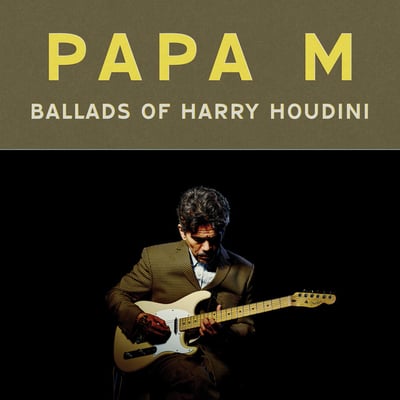
Papa M Ballads of Harry Houdini
Released Nov 22, 2024 Drag City
Consensus forming 4 professional reviews Updated Dec 29, 2025
Broadly positive consensus
Consensus is still forming across 4 professional reviews. Papa M's Ballads of Harry Houdini stakes a quietly defiant claim: a return that favors patient guitar narratives and left-field shifts over slick immediacy.
How ChoruScore worksCritics' Top Tracks
The songs critics returned to most
Good Riddance
1 critic mention
“she manages a perky as well as gorgeously floaty, cathartic, if still bittersweet final track - Good Riddance” — Song Bar
Math Equation
1 critic mention
“On Math Equation, for example: "You said I needed my own friends / So I found them / Then you fucked them.” — Song Bar
Amnesia
1 critic mention
“the more downbeat but rather beautifully sung opener Amnesia: "I’m an aperture /Of deleterious radicals / I know I tried / To reverse the damage.” — Song Bar
Full critic consensus
Papa M's Ballads of Harry Houdini stakes a quietly defiant claim: a return that favors patient guitar narratives and left-field shifts over slick immediacy. Across professional reviews, critics point to repetition and thematic evolution as the record's spine, and the consensus suggests this collection rewards close, repeated listens rather than instant gratification.
Reviewers consistently praise standout tracks like “Ode To Mark White”, “Barfighter” and “Good Riddance” for balancing melancholy with unexpected hooks. The Quietus and The Observer highlight the album's gravelly folk voice and instrumental experimentation, from kosmische noodling to Slint-tinged passages, while Song Bar and Tinnitist emphasise the album's groove, wry humour and dance-pop/electronica detours on songs such as “Math Equation” and “Amnesia”. Across four professional reviews the record earned an 80.5/100 consensus score, with critics noting its emotional resonance, blues influence and the songwriter's knack for turning repetition into narrative momentum.
There is nuance: some critics admire the album's patient craftsmanship and bittersweet irony, while others signal that its short length and elliptical approach may frustrate those seeking more immediate payoff. Still, the critical consensus frames Ballads of Harry Houdini as a focused, often compelling hybrid of folk balladry and sleazy groove - a record that confirms Papa M's solo craftsmanship and rewards listeners who prefer textured, introspective work over pop polish. Read on for full reviews and track-by-track notes that unpack why critics call out these as the best songs on Ballads of Harry Houdini.
Track Ratings
How critics rated each track, relative to this album (0-100). Only tracks that made critics feel something are rated.
Thank You For Talking To Me (When I Was Fat)
Ode To Mark White
People’s Free Food Program
Barfighter
Rainbow of Gloom
Devil Tongue
Get the next albums worth your time.
Critic-backed picks in one clean digest. No clutter.
What Critics Are Saying
Deep insights from 4 critics who reviewed this album

Critic's Take
David Pajo remains the cult figure who prioritises musical quality, and on Ballads of Harry Houdini the best songs - notably “Ode To Mark White” and “Rainbow Of Gloom” - reveal that mix of gravelly folk and catchy despair the record thrives on. Moores’s eye for detail surfaces as he tracks the album from the muted chug of the opener to the kosmische noodles of the midsection, arguing that these standout tracks show why the album, though short, feels more focused. The review reads as a steady appreciation rather than hyperbole, pointing to the journey and Pajo’s ability to reconceive forms, especially on “Barfighter” and “Devil Tongue” which recast familiar motifs in fresh, engrossing ways.
Key Points
-
“Ode To Mark White” stands out for its waltzing folk structure, gravelly vocals and evolving dynamics.
-
The album’s core strengths are Pajo’s genre-bending arrangements and an engrossing, exploratory sense of journey.
Themes

Th
Critic's Take
Papa M remains the spotlight-shy guitarist whose latest Ballads of Harry Houdini foregrounds his strengths: repetition, thematic evolution and a worn, characterful voice. The review lingers on “People's Free Food Program” and “Thank You For Talking to Me (When I Was Fat)” as two longer, on-brand instrumentals that put his anchoring repetition front and centre, while “Ode to Mark White” is singled out as the closest thing to a ballad, Pajo husking like Tom Waits. The tone admires the album's emotional resonance without indulging hyperbole, noting stylistic variety and a Slinty passage in “Barfighter” that nods to his Slint past. This is a record for listeners drawn to patient guitar narratives and a singer who makes rough-hewn lines sound like confessions.
Key Points
-
The best songs are the two longer instrumentals, especially "People's Free Food Program", because they foreground Pajo's anchoring repetition and thematic evolution.
-
The album's core strengths are patient, left-field guitar work, emotional resonance, and a voice that lends balladry a rough, confessional edge.
Themes

Critic's Take
In his wired, jokingly reverent tone Darryl Sterdan presents Papa M’s Ballads of Harry Houdini as a triumphant return, praising the six "fat-assed songs" and calling out the record’s groove and sleaze. He singles out the album’s mix of ballads and "all-out groovers," implying that tracks like “Thank You For Talking To Me (When I Was Fat)” and “Barfighter” showcase the record’s best moments, where blues scaling meets "insistent torn-n-fucked delirium." Sterdan’s voice is playful and hyperbolic, insisting this Papa M can still "show us how it’s done," which answers the query about the best songs on Ballads of Harry Houdini by pointing to its most groove-heavy cuts. The review reads like a lived-in endorsement: raw, amused, and confident that these songs make you move, sing or otherwise lose restraint.
Key Points
-
The best song(s) are the groove-heavy "fat-assed" tracks such as "Thank You For Talking To Me (When I Was Fat)", which exemplify the album’s irresistible sleaze and groove.
-
The album’s core strengths are solo craftsmanship, confident grooves, bluesy scaling, and a playful yet assured production that makes these six songs feel vital.