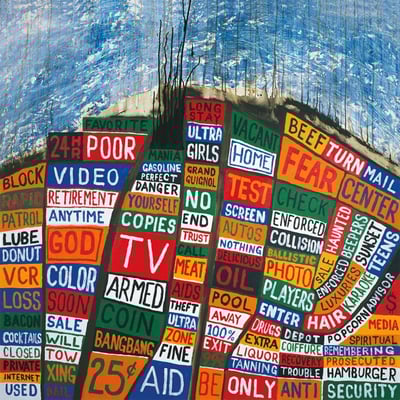
Radiohead Hail to the Thief
Released Jun 9, 2003 XL Recordings
Established consensus 20 professional reviews Updated Mar 23, 2026
Broadly positive consensus
Radiohead's Hail to the Thief arrives as a restless, often thrilling collision of arena-scale songcraft and electronic experimentation, and critics largely agree its strongest moments justify close attention.
How ChoruScore worksCritics' Top Tracks
The songs critics returned to most
There, There
10 critic mentions
“the clanging guitars and piercing falsetto sighs of lead-off single "There There” — Uncut
Myxomatosis
9 critic mentions
“Consider "Myxomatosis," definitely the best song ever about a diseased mongrel cat.” — Rolling Stone
2 + 2 = 5
8 critic mentions
“Opener "2 + 2 = 5" begins with a simple vocal line, kicks into a surging guitar chorus” — Entertainment Weekly
Full critic consensus
Radiohead's Hail to the Thief arrives as a restless, often thrilling collision of arena-scale songcraft and electronic experimentation, and critics largely agree its strongest moments justify close attention. Across 20 professional reviews the record earned a 79.35/100 consensus score, with reviewers repeatedly flagging tracks such as “There, There”, “2 + 2 = 5”, “Myxomatosis” and “A Wolf at the Door” as standout songs that balance tunefulness with paranoia and political urgency. Those searching for the best songs on Hail to the Thief will find the muscular groove of “There, There”, the opener's furious surge on “2 + 2 = 5”, and the grim charm of “Myxomatosis” repeatedly cited by critics.
Track Ratings
How critics rated each track, relative to this album (0-100). Only tracks that made critics feel something are rated.
2 + 2 = 5
Sit Down. Stand Up
Sail to the Moon
Backdrifts
Go to Sleep
Where I End and You Begin
We Suck Young Blood
The Gloaming
There, There
I Will
A Punch Up at a Wedding
Myxomatosis
Scatterbrain
A Wolf at the Door
Get the next albums worth your time.
Critic-backed picks in one clean digest. No clutter.
What Critics Are Saying
Deep insights from 20 critics who reviewed this album
Dr
Critic's Take
Radiohead on Hail to the Thief sound like a band at a crossroads, equal parts sardonic pamphleteer and wounded romantic, which is why the best songs on Hail to the Thief - notably “2 + 2 = 5” and “Where I End and You Begin” - land so potently. The opener “2 + 2 = 5” fuses tempering electronica with feverish guitar explosions and sets the record's Orwellian politics, while “Where I End and You Begin” is an urgent, bass-driven standout that pulls the electronic experiments back into raw rock. Elsewhere the fragile, piano-led “Sail to the Moon” and the brief revelation “I Will” showcase Yorke's voice as the record's centrepiece, fragile and angelic. Taken together, these tracks explain why listeners searching for the best songs on Hail to the Thief will find the album rewards repeated, attentive plays.
Key Points
-
The best song is the opener “2 + 2 = 5” because it fuses political urgency with explosive guitars and electronic tension.
-
The album’s core strengths are Yorke's prominent, fragile vocals and the successful hybrid of electronic textures with rock dynamics.
Themes
Ev
Sp

Critic's Take
In this reviewer's jagged, conversational tone the best tracks on Hail to the Thief are unmistakeable: the triumphant opener “2 + 2 = 5” establishes intent, while “There There” unifies the band in a thundering, strangely straightforward anthem. The writer praises the risk-taking on “Backdrifts” and “The Gloaming” as beacons of Radiohead's experimental future, and crowns closing moments like “A Wolf at the Door” and “Myxomatosis” as some of the album's finest. Overall the narrative frames the record as a sometimes imperfect holding pattern, yet one rich with moments that qualify as the best songs on Hail to the Thief.
Key Points
-
The best song is "There There" because it unifies Radiohead's aims into a powerful, anthemic crescendo.
-
The album's strengths are its experimental risks and several standout rock moments that balance ambition and immediacy.
Themes
En
Critic's Take
Radiohead sound like a band reclaiming songcraft on Hail to the Thief, and the best tracks on Hail to the Thief - notably “There, There” and “A Wolf at the Door” - illustrate that shift. The reviewer's voice relishes Yorke front and center, praising “There There” for its "gorgeous, gliding" vocal and calling “A Wolf at the Door” a "soaring paranoid fantasy" that makes the closer the album's real highlight. Lesser moments exist and the record drags midstream, but the strong finish and songs like “Scatterbrain” show Radiohead moving comfortably back toward emotionally direct, elegant compositions. Overall, the best songs on Hail to the Thief reward repeated listens and reveal why this record feels like a step forward after Radiohead's recent experiments.
Key Points
-
The closer "A Wolf at the Door" is the album's emotional and artistic high point, sealing the record's success.
Themes
Co
Critic's Take
Radiohead's Hail to the Thief often reads like a band trying to reconcile its past and present, and the best songs - notably “2 + 2 = 5” and “There There” - prove that balance can work. The reviewer's voice is conversational and self-aware, calling the opener “2 + 2 = 5” an "absolute success" while praising “There There” as an "excellent" single that returns melody to the foreground. Other highlights like “Myxomatosis” and “We Suck Young Blood” are noted for atmosphere and melody respectively, even as the record occasionally stumbles in sequencing and experimental detours. Overall the narrative frames the album as accessible and frequently rewarding, yet uneven - a near return to form that still wrestles with identity.
Key Points
-
The best song is "2 + 2 = 5" for balancing guitar propulsion with focused production, making it an 'absolute success'.
-
The album's core strength is marrying accessible melody with subtle experimentation, even if sequencing and some experimental tracks disrupt flow.
Themes

Critic's Take
Radiohead’s Hail to the Thief is not the longed-for return to OK Computer, but it is magnificently engaging and expansive, trading pure expectation for strange hybrid rewards. The review relishes the weary, washed-out plod of “We Suck Young Blood” and the space-jazz vault of “Myxomatosis”, while celebrating the spectral piano lullaby of “Sail to the Moon” as among the best songs on Hail to the Thief. The tone is admiring and a little weary, insisting that initial disappointment fades and multiple hearings reveal the album’s strengths. This is a record that wears its monsters proudly, and those best tracks - “We Suck Young Blood”, “Myxomatosis” and “Sail to the Moon” - carry its gothic, hybrid heart.
Key Points
-
The best song(s) excel by marrying gothic atmosphere with distinct sonic invention, as in "Myxomatosis" and "We Suck Young Blood".
-
The album’s core strength is its hybrid fusion of experimental textures and accessible anthemic moments that reward repeated listens.
Themes

Critic's Take
Radiohead's Hail to the Thief feels of its moment, furious and mordant but musically inviting, which is why listeners hunting for the best songs on Hail to the Thief keep coming back to “There, There” and “Myxomatosis”. The reviewer's voice lingers on the percussive, mesmerizing groove of “There, There”, calling it especially tuneful amid Radiohead's paranoia. Equally, the oddball poetry of “Myxomatosis” is lauded as a strange highlight - a funny, filthy charm that sticks. The closer “A Wolf at the Door” is singled out as a sad, dark and witty finale that helps make these the best tracks on Hail to the Thief.
Key Points
-
The best song is "There, There" for its percussive, mesmerizing groove and tunefulness.
-
The album's core strengths are its political anger paired with unexpectedly catchy, melodic songwriting.
Themes

Critic's Take
Radiohead put together familiar influences on Hail to the Thief, and the best tracks - “2 + 2 = 5”, “There There” and “Myxomatosis” - are where the band briefly recapture past majesty, with jagged guitars, hypnotic percussion and vitriolic intensity. Despite those highs, the collection feels fragmented rather than coherent, leaving the listener impressed by individual songs but unsure of the whole.
Key Points
-
The best song is “2 + 2 = 5” because it is described as the band's most rocking moment with rapid tempo and mood shifts.

NO
Critic's Take
Radiohead sound like a band reasserting purpose on Hail To The Thief, where the marriage of electronics and arena rock finally feels decisive. The review singles out “There, There” as the album's muscular centerpiece and treats “A Punch Up at a Wedding” as a loping, beautiful risk that pays off. The writer's tone is admiring but measured, arguing these best songs show why the record is the most accomplished integration yet. For listeners searching for the best songs on Hail To The Thief, start with “There, There” and “A Punch Up at a Wedding” for how experimentation and big-rock songwriting cohere.
Key Points
-
The best song, “There, There”, exemplifies how Radiohead marry arena-scale rock with experimental textures.
-
The album's core strength is its purposeful fusion of electronic experimentation and established rock songwriting.
Themes
Ar

Critic's Take
Radiohead approaches Hail to the Thief as a band balancing the pull of past glories with forward motion, and the best songs prove that mix. The opener “2 + 2 = 5” and “Sit Down. Stand Up” convert simmering mood into cathartic tantrum, making them two of the best tracks on Hail to the Thief. The spook-filled “Sail to the Moon” rises as another highlight, a piano-led piece that hovers compellingly like the group’s earlier work. Overall, the album’s substantial impact comes less from cohesion and more from moments where traditional songcraft meets adventurous drive.
Key Points
-
The best songs, notably "2 + 2 = 5" and "Sit Down. Stand Up", succeed by turning simmer into cathartic release.
-
The album’s core strength is marrying relatively traditional songcraft with adventurous textures and emotional impact.
Themes
Ho

Critic's Take
Radiohead's Hail to the Thief is frustratingly split between invention and indulgence, yet its best songs still shine. The reviewer's ear is caught most by “Sail to the Moon”, the piano-led ballad that stands out as the album's outstanding track, and by the intimate pair “I Will” and “A Wolf at the Door” which expose Thom Yorke's parental anxieties. He praises the direct surge of guitar on “2 + 2 = 5” and the warm immediacy of “Scatterbrain”, while criticizing the brittle programming of “Sit Down. Stand Up” and the underwhelming single “There, There” for breaking momentum. Overall the reviewer frames the record as good rather than great, its highlights dulled by extraneous electronic pieces and slack running time.
Key Points
-
The piano-led “Sail to the Moon” is the album's best song for its affecting intimacy and strong melody.
-
The album's core strength is moments of direct, intimate songwriting and striking guitar work, undermined by indifferent electronic pieces.
Themes
Ti

Critic's Take
Radiohead's Hail to the Thief finds its best songs where light punctures the gloom, notably "Sail to the Moon" and "A Punch Up at a Wedding". Petridis's tone stays wry and slightly exasperated, praising "Sail to the Moon" as a "woozy lovely song" about Yorke's son and calling "A Punch Up at a Wedding" "even better", a "positive hoot" with a "funky bassline". He positions these as the album's clearest rewards amid familiar glitch techno and self-parodic bleakness.
Key Points
-
Sail to the Moon is best for its woozy, tender celebration of Yorke's son.
-
The album's core strength is moments of light breaking through electronic gloom and witty songwriting like A Punch Up at a Wedding.
Themes

Critic's Take
Radiohead's Hail to the Thief finds its best tracks when Yorke's paranoia and accessible melodies collide, namely “Where I End and You Begin” and “We Suck Young Blood”. Sal Cinquemani writes in measured, comparative prose that the album sits between Kid A and OK Computer, praising the grounded vocals on “Where I End and You Begin” while admiring the creepy dirge of “We Suck Young Blood”. The review frames these as the best songs on Hail to the Thief, examples of Radiohead inching back toward melodic clarity without abandoning their computerized textures.
Key Points
-
“Where I End and You Begin” is the album's standout for its grounded, accessible vocals and lyrics.
Themes
En
Critic's Take
Radiohead sound more guitar-forward on Hail to the Thief yet remain stubbornly experimental, and the best songs show that tension at work. The reviewer singles out “Where I End and You Begin” as a febrile, itchy shuffle and “Go to Sleep” for its perverse time-signature and forceful rhythm, marking them among the best tracks on Hail to the Thief. There's also praise for the plaintive setting of “We Suck Young Blood” and the single “There There” as a rumination on uncertainty, all examples of the album's knack for marrying avant-garde textures to rock drive. This is an album where political bile and alienation fuel songs that are frequently compelling, if occasionally mannered.
Key Points
-
The best song channels Radiohead's avant-garde impulses into propulsive rock, making it emotionally febrile and musically compelling.
-
The album's core strengths are its fusion of guitar-driven songcraft with electronic textures and its focus on paranoia and political duplicity.