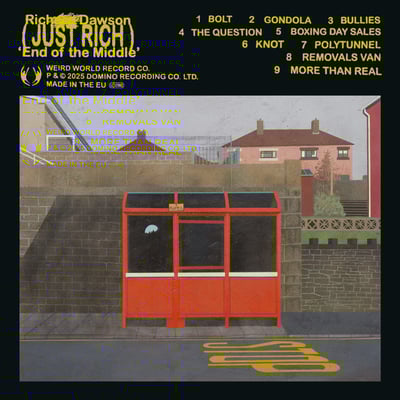
Richard Dawson End of the Middle
Released Feb 14, 2025 Weird World
Established consensus 11 professional reviews Updated Aug 27, 2026
Broadly positive consensus
Richard Dawson's End of the Middle turns inward, casting its gaze on everyday British life and domestic detail to striking effect, and the critics' consensus suggests the record largely succeeds.
How ChoruScore worksCritics' Top Tracks
The songs critics returned to most
Polytunnel
2 critic mentions
“Polytunnel", which brings to mind Mike Leigh's 2010 film Another Year” — PopMatters
More than real
2 critic mentions
“the finale "More Than Real". Her vocal and synthesizer contributions make the track sonically distinct” — PopMatters
Bolt
2 critic mentions
“Faye MacCalman’s “clarinet bolts of lightning”, which feature on most of the record's songs following “Bolt” — PopMatters
Full critic consensus
Richard Dawson's End of the Middle turns inward, casting its gaze on everyday British life and domestic detail to striking effect, and the critics' consensus suggests the record largely succeeds. Across 11 professional reviews the album earned an 80.45/100 consensus score, with reviewers repeatedly praising Dawson's spare arrangements, vivid storytelling and the warmth that threads through otherwise bleak observations of consumerism, isolation and intergenerational patterns of behaviour. Songs emerge as intimate vignettes rather than grand pronouncements, a quality that critics identify as the album's chief strength.
Reviewers consistently point to several standout tracks: “Polytunnel” is singled out for its allotment catharsis and close observation, “More than real” draws notice for Sally Pilkington's elegiac vocal counterpoint, and “Bolt” is celebrated for its clarinet-led flashes of lyricism. Critics note recurring themes of family life, repetition of behaviour and domesticity, with “Bullies” named for its unflinching look at violence passed down through generations. While some reviews register reservation about the album's narrow focus, the overall critical reception frames End of the Middle as a rewarding, humane collection where small musical gestures amplify the emotional stakes.
Taken together, the professional reviews suggest that End of the Middle is worth attention for those drawn to poetic storytelling and textured, modest arrangements; the consensus score and repeated praise for tracks like “Polytunnel”, “More than real” and “Bolt” make a persuasive case for its place in Dawson's catalogue and for further listening.
Track Ratings
How critics rated each track, relative to this album (0-100). Only tracks that made critics feel something are rated.
Bolt
Gondola
Bullies
The question
Boxing Day sales
Knot
Polytunnel
Removals van
More than real
Get the next albums worth your time.
Critic-backed picks in one clean digest. No clutter.
What Critics Are Saying
Deep insights from 11 critics who reviewed this album

mu

Critic's Take
Richard Dawson's End of the Middle narrows his canvas to domestic detail and it pays off, making the best songs here quietly devastating. The record's charms radiate from “Bolt” with its clarinet "bolts of lightning" and from the elegiac “More than real” with Sally Pilkington's distinct vocals, both songs showing why listeners ask about the best tracks on End of the Middle. Thomas Britt's tone is measured and appreciative, noting that “The Question” is one of the LP's highlights and that “Removals Van” ends in hope rather than emptiness. This is Dawson shifted inward, where storytelling and small musical gestures make certain songs stand out as the best songs on the album.
Key Points
-
The best song work centers on intimacy and small gestures, notably “Bolt” and “More than real” for their emotional clarity.
-
The album's core strength is its tightened focus on domestic storytelling, where restrained music highlights trenchant lyrics.
Themes


Th
Critic's Take
Phil Mongredien writes in measured, admiring tones that Richard Dawson's End of the Middle finds its best tracks in domestic, quietly astonished scenes - “Polytunnel” stands out for its allotment catharsis and textured detail, while “Bullies” nails the cyclical violence passed from father to son. He praises Dawson's spare arrangements and storytelling, arguing these qualities make the best songs on End of the Middle feel immediate and humane. The result reads like a series of intimate vignettes rather than grand concept pieces, which is precisely the album's strength.
Key Points
-
Polytunnel is the best song for its cathartic allotment vignette and emotional immediacy.
Themes


