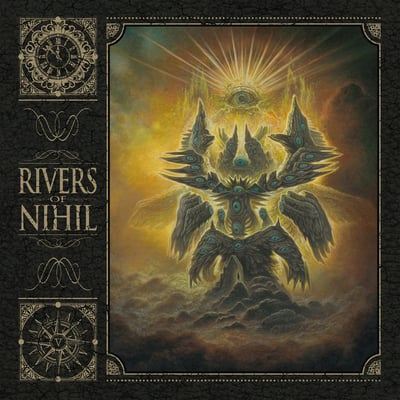
Rivers of Nihil Rivers of Nihil
Released May 30, 2025 Metal Blade Records
Established consensus 5 professional reviews Updated Feb 21, 2026
Mostly positive consensus
Rivers of Nihil's Rivers of Nihil opens with a statement of intent: sharper, angrier and more focused than some recent work, the self-titled record often marries crushing heaviness with unexpected melodic flights.
How ChoruScore worksCritics' Top Tracks
The songs critics returned to most
The Sub-Orbital Blues
4 critic mentions
“Songs like "The Sub-Orbital Blues" work despite the simple guitar work due to its high energy on the drums” — Angry Metal Guy
Dustman
3 critic mentions
“Dustman" and " Criminals" are both tightly structured, prog death diamonds” — Blabbermouth
Criminals
3 critic mentions
“he brings a lot to the table, particularly on Criminals, which pitches pointed hostility against an eerie whispered passage” — Kerrang!
Full critic consensus
Rivers of Nihil's Rivers of Nihil opens with a statement of intent: sharper, angrier and more focused than some recent work, the self-titled record often marries crushing heaviness with unexpected melodic flights. Across five professional reviews the consensus lands squarely in praise with caveats, the album earning a 74/100 consensus score from five reviews that celebrate its high points while noting moments of inconsistency.
Critics consistently singled out a handful of standout tracks as proof of the band's renewed charge. “The Sub-Orbital Blues” is repeatedly named for its ability to both soar and pummel, while “Dustman” gets credit for breakneck percussion and crushing breakdowns. “Water & Time” and “The Logical End” earn praise for sprawling prog textures, synths and Patrick Corona's saxophone, and “Criminals” and “House of Light” are singled out for vocal turns and melodic lift. Reviewers consistently note a blend of melody and brutality, with prog instrumentation, cinematic arrangements and sociopolitical anger threaded through the record.
That blend produces mixed reactions: some critics hail the album as a confident reinvention and an evolution of the progressive death metal template, while others flag songwriting inconsistency and a back half that lapses into repetitive riffs. The lineup change and vocal shifts register across reviews as both a source of fresh energy and a reason certain tracks feel less fully formed. Taken together, the critical consensus suggests Rivers of Nihil contains several must-listen, standout tracks and enough ambition to make it worth exploring for anyone tracking the band's evolution.
Below, detailed reviews unpack where the record succeeds and where it stumbles in the context of Rivers of Nihil's catalog.
Track Ratings
How critics rated each track, relative to this album (0-100). Only tracks that made critics feel something are rated.
The Sub-Orbital Blues
Dustman
Criminals
Despair Church
Water & Time
House of Light
Evidence
American Death
The Logical End
Rivers of Nihil
Get the next albums worth your time.
Critic-backed picks in one clean digest. No clutter.
What Critics Are Saying
Deep insights from 6 critics who reviewed this album
Di
Critic's Take
Rivers of Nihil sound like a band resetting the clock on their own terms, and on Rivers of Nihil the best tracks prove it. The bludgeoning, rampaging “Dustman” stands out for Jared Klein's breakneck blast beats and crushing breakdowns, while the sprawling prog epic “Water & Time” showcases synths and Patrick Corona's saxophone to brilliant effect. “The Logical End” also merits mention for its polyrhythmic riffs and post-metal expanse, and the succinct title track ties the record together by blending sinister openings with bruising final thirds. This is a confident, experimental record where the best songs - namely “Dustman”, “Water & Time” and “The Logical End” - reveal a band coming fully into the sunlight.
Key Points
-
The best song, "Dustman", is best for its relentless drumming, breakneck blast beats and crushing breakdown.
-
The album's core strengths are confident reinvention, successful experimentation with synths and saxophone, and strong songwriting after lineup changes.
Themes
Me
Critic's Take
Rivers of Nihil's self-titled record reads like a charged rallying cry, and its best songs - particularly “The Sub-Orbital Blues”, “Dustman”, and “American Death” - carry that fury with cinematic heft. The reviewer leans into the album's sociopolitical criticism and relentless instrumentals, noting how tracks such as “Criminals” and “The Logical End” push the narrative forward. Sonically sound and emotionally poignant, the record bubbles and boils with rigorous riffs and tumultuous melodies that make these songs stand out. That blend of anger and cinematic scope is why listeners seeking the best tracks on Rivers of Nihil should start with those charged highlights.
Key Points
-
The best song(s) stand out for marrying sociopolitical fury with cinematic, tumultuous instrumentals.
-
The album's core strengths are its charged lyrical critique and sonically cinematic, emotionally poignant arrangements.
Themes
Bl
Critic's Take
From the opening charge of “The Sub-Orbital Blues” to the dreamlike sweep of “The Logical End”, Rivers of Nihil deliver a self-evident, confident consolidation on Rivers of Nihil. The record trades the unfettered prog explosions of its predecessor for a leaner, razor-sharp set where songs like “House Of Light” and “American Death” stand out as immediate highlights. The band marries brutal death metal torque with wilful, eccentric prog touches - saxophones, Mellotrons and even banjo - and it yields some of the best tracks on Rivers of Nihil. This is an unmissable, highly melodic metal effort that feels both classy and dangerously alive.
Key Points
-
House Of Light is the best song because it encapsulates the album's next-level progressive death and showcases the vocalist.
-
The album's core strength is melding brutal death metal with eccentric prog instrumentation and melodic songcraft.
Themes

Critic's Take
Rivers of Nihil have not so much reinvented themselves as sharpened their identity on Rivers of Nihil, and the best songs show that honing most clearly. Opener “The Sub-Orbital Blues” both soars and pummels, setting the template, while “Criminals” is a highlight thanks to Adam Biggs's lead vocal turn and its pitched hostility against an eerie whispered passage. Those two tracks best answer questions about the best songs on Rivers of Nihil, because they combine the tougher heaviness and flowing melodic passages that the record favours. The record cements their position more than it expands it, so the standout moments are where sharpening meets ambition.
Key Points
-
The Sub-Orbital Blues is best because it sets the album's tone by both soaring and pummelling.
-
The album's core strength is sharpening their heavier elements while letting melodic passages flow.
Themes

An
Critic's Take
- With Jake Dieffenbach gone and Adam Biggs plus Andy Thomas stepping up, Rivers of Nihil stakes a claim for reinvention on Rivers of Nihil, yet the best songs here are the ones that remember their prog roots. Tracks like “Water & Time” and “House of Light” strike the balance between gentle and rough, showcasing Thomas’s soaring choruses and the saxophone’s melodic lift. The more energetic “The Sub-Orbital Blues” proves that punchy drums and vocal interplay can overcome simpler guitar work. Sadly, the back half collapses into repetitive, uninspired riffs, with “American Death” and “The Logical End” exemplifying the album’s worst instincts.
Key Points
-
House of Light is best for its balanced vocals, sax presence, and prog sensibility.
-
The album’s core strengths are the new vocal pairing and expanded saxophone, offset by inconsistent songwriting and poor production.