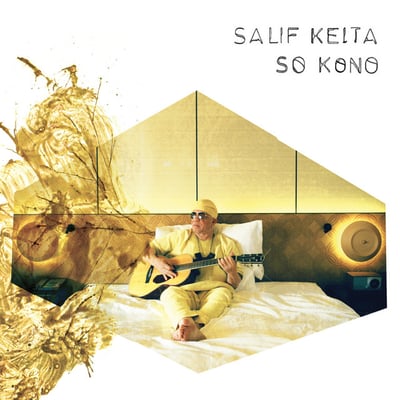
Salif Keita So Kono
Released Apr 11, 2025 No Format!
Established consensus 5 professional reviews Updated Feb 21, 2026
Strong critical consensus
Salif Keita's So Kono returns the Malian legend to a startlingly spare soundscape, where mature vocals and ancestral melodies take precedence over studio gloss.
How ChoruScore worksCritics' Top Tracks
The songs critics returned to most
Proud
5 critic mentions
“By the time he hits the French- and English-language verses of final track "Proud" ("Am what I am and proud / Am African and proud / Am albino and proud / Am different and proud"), the pride he takes in his work is already abundantly clear” — PopMatters
Tassi
3 critic mentions
“Tassi", a piece of bubblegum Latin pop from his 2012 LP Talé, is turned into a hypnotic meditation.” — Uncut
Laban
2 critic mentions
“Laban", a piece of desert rock on his 2005 album M’Bemba, is turned into a wonderfully baroque miniature,” — Uncut
Full critic consensus
Salif Keita's So Kono returns the Malian legend to a startlingly spare soundscape, where mature vocals and ancestral melodies take precedence over studio gloss. Across five professional reviews the record earned an 85.6/100 consensus score, and critics consistently point to a handful of songs as the record's emotional core, notably “Proud”, “Aboubakrin” and “Tassi”.
Reviewers agree that the album's pared-back arrangements - stripped-down ngoni, calabash percussion and hypnotic guitar loops - sharpen Keita's vocal mastery and foreground themes of heritage, reflection and pride. Uncut and PopMatters highlight how tracks such as “Proud” and “Soundiata” become meditative sigils of identity, while Mojo and The Observer praise reworkings of older material like “Laban” and “Tassi” for feeling reverent rather than merely nostalgic. Critics consistently note the record's intimacy and minimalism, where quiet textures let Keita's huskier, sovereign timbre do the narrating.
Not without nuance, some reviewers flag occasional moments of percussion that jar the austerity, but the dominant consensus across professional reviews frames So Kono as a triumphant return from retirement that emphasizes voice and legacy. For those asking what the best songs on So Kono are, repeated praise for “Proud”, “Aboubakrin” and “Tassi” suggests the album rewards attentive, repeated listening. Below, the full reviews unpack how this collection situates Keita's late-career artistry within Malian tradition and intimate modernity.
Track Ratings
How critics rated each track, relative to this album (0-100). Only tracks that made critics feel something are rated.
Aboubakrin
Awa
Tassi
Kanté Manfila
Chérie
Soundiata
Laban
Tu vas me manquer
Proud
Get the next albums worth your time.
Critic-backed picks in one clean digest. No clutter.
What Critics Are Saying
Deep insights from 6 critics who reviewed this album

Critic's Take
Salif Keita sounds at once vulnerable and sovereign on So Kono, and the review makes clear the best tracks showcase that vocal centrality. The opener “Aboubakrin” is praised for shifting cadence between quick, intense verses and velvet choruses, while “Awa” and “Chérie” are singled out for gravity and sweetness respectively. The reviewer emphasizes stripped-down arrangements - Keita alone with acoustic guitar lets songs like “Soundiata” and the closing “Proud” carry emotional weight. Overall, the album’s best songs are those that foreground his voice and storytelling, making the minimal approach feel like a bold, rewarding risk.
Key Points
-
The best song, "Aboubakrin", is best because it foregrounds Keita's flexible cadence and velvet choruses.
-
The album’s core strengths are its intimate, vocal-forward arrangements and emotional directness.
Themes

Critic's Take
Salif Keita wears his history lightly on So Kono, and the best tracks - notably “Soundiata” and “Proud” - show him balancing tradition and small, modern ambitions with ease. The review praises Keita's voice and lineage, and treats songs like “Soundiata” as exemplars of his command rather than mere nostalgia. It is these assured moments that answer listeners asking for the best tracks on So Kono, where quiet authority outshines ornamentation. The narrative suggests the album's high points arise from rooted songwriting and Keita's unmistakable delivery.
Key Points
-
The best song is best because it showcases Keita's vocal command and fusion of tradition with subtle modern touches.
Themes
mu
Th
Critic's Take
Salif Keita returns on So Kono with a pared-back palette that lets his matured, huskier timbre command attention. The review keeps steering listeners to the best tracks - “Aboubakrin” and “Tassi” for their plaintive ngoni loops and raw emotion, and “Proud” as the album's highlight for its nimble delivery and soaring climax. Ammar Kalia’s voice is appraising but affectionate, noting moments of stripped-back beauty alongside occasional jarring percussion. The result is an album where the strongest songs showcase Keita’s enduring power rather than studio gloss.
Key Points
-
Proud is best for its nimble delivery, soaring climax and demonstration of Keita’s enduring vocal power.
-
The album’s core strengths are its sparse arrangements and Keita’s matured, huskier voice that creates moments of stripped-back beauty.
Themes

Critic's Take
Salif Keita returns on So Kono with a remarkably intimate set that puts his voice front and centre, and the best songs - notably “Kanté Manfila” and “Laban” - feel like quiet, powerful tributes. The album favours spare ngoni and calabash percussion over lush production, so the highlight is how those pared-back textures let Keita's magnificence cut through. He even revisits older material - “Tassi” and “Laban” - and the results are moving rather than merely nostalgic. For listeners searching for the best tracks on So Kono, these intimate performances reward close attention and repeated plays.
Key Points
-
The best song is likely "Kanté Manfila" because it is singled out as the highlight and a moving tribute.
-
The album's core strength is its stripped-back arrangements that foreground Keita's magnificent voice.
Themes

Critic's Take
Salif Keita returns with So Kono, an austere, intimate set that foregrounds his vocal pyrotechnics and hypnotic guitar patterns. The reviewer singles out “Proud” as most startling, a raw, howling summation of identity, while quieter reworkings like “Tu Vas Me Manquer” and “Tassi” show how minimal arrangement sharpens emotional impact. There is constant praise for the album’s trance-like guitar and the way songs such as “Laban” and “Awa” are transformed into baroque, meditative miniatures. The result is a recording that answers the question of the best songs on So Kono by letting Keita’s voice and a few top tracks do the talking.
Key Points
-
The best song, "Proud", is best for its startling simbi arrangement and visceral, proud howled vocals.
-
The album's core strength is its spare, trance-like guitar that spotlights Keita's extraordinary voice and personal themes.