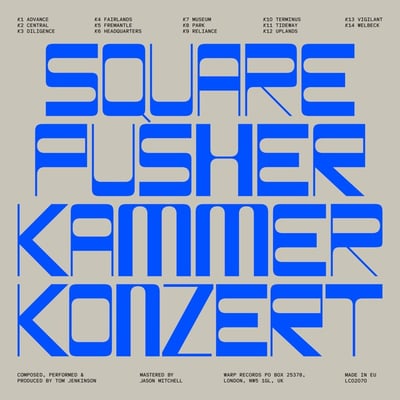
Squarepusher Kammerkonzert
Released Apr 10, 2026 Warp Records
Established consensus 5 professional reviews Updated Apr 15, 2026
Mostly positive consensus
Squarepusher's Kammerkonzert finds Tom Jenkinson deepening the dialogue between chamber textures and electronic mischief, and across professional reviews the record is largely seen as a rewarding, if occasionally divisive, experiment in orchestral-electronic fusion.
How ChoruScore worksCritics' Top Tracks
The songs critics returned to most
K6 Headquarters
1 critic mention
K7 Museum
2 critic mentions
“The Zappa-esque "K7 Museum," for one, crescendos with such compositional acuity that it borders on showstopping.” — Slant Magazine
K2 Central
1 critic mention
“incorporates a slow electro-funk drum machine rhythm matched with funky fusion bass” — AllMusic
Full critic consensus
Squarepusher's Kammerkonzert finds Tom Jenkinson deepening the dialogue between chamber textures and electronic mischief, and across professional reviews the record is largely seen as a rewarding, if occasionally divisive, experiment in orchestral-electronic fusion. Critics note that the album's strengths lie in its textural contrasts - moments of austerity that erupt into maximalist runs - and in the composer-producer's confident command of jazz-fusion and avant-chamber-prog language.
The critical consensus sits at a 74/100 across five professional reviews, with reviewers consistently praising tracks that marry orchestral color to rhythmic inventiveness. Standout tracks repeatedly called out include “K6 Headquarters”, “K7 Museum”, “K10 Terminus” and “K14 Welbeck”. Across reviews from AllMusic, Far Out Magazine and Slant Magazine, critics praised the album's orchestral-lite arrangements and inventive timbral swaps - glockenspiels, fortepiano runs and creeping strings - as evidence of Jenkinson's mastery of craft, even as some felt the record recycles ideas rather than offering wholly new directions.
That tension gives Kammerkonzert its peculiar charm: reviewers agree the best songs on Kammerkonzert reward patient listening, with perky, head-spinning moments like “K10 Terminus” and the austere centerpiece “K5 Fremantle” showing both whimsy and darkness. For listeners wondering what critics say about Kammerkonzert, the consensus suggests a refined, sometimes polarizing late-period work that is worth hearing for its compositional risks and standout track moments.
Track Ratings
How critics rated each track, relative to this album (0-100). Only tracks that made critics feel something are rated.
K1 Advance
K2 Central
K3 Diligence
K4 Fairlands
K5 Fremantle
K6 Headquarters
K7 Museum
K8 Park
K9 Reliance
K10 Terminus
K11 Tideway
K12 Uplands
K13 Vigilant
K14 Welbeck
Get the next albums worth your time.
Critic-backed picks in one clean digest. No clutter.
What Critics Are Saying
Deep insights from 5 critics who reviewed this album

Critic's Take
Squarepusher's Kammerkonzert finds Tom Jenkinson relishing compositional risk, and the best songs on Kammerkonzert are emphatically the ones that marry orchestral color with rhythmic mischief. “K4 Fairlands” stands out for folding choppy breakbeats into creeping strings, while “K2 Central” pairs slow electro-funk drums with rising strings to great effect. The head-spinning “K10 Terminus” and gleeful “K13 Vigilant” supply irresistible perky moments, and the ominous, drumless centerpiece “K5 Fremantle” proves the album can be dark and surreal as well. This is a complex, ambitious record that will be divisive, but its best tracks reward repeated listening.
Key Points
-
K4 Fairlands is best for its bold fusion of breakbeats, strings, and synth sequences.
-
The album's strengths are its ambitious orchestration, rhythmic invention, and playful-yet-ominous contrasts.
Themes


Fa
Critic's Take
Squarepusher’s Kammerkonzert rewards the patient listener, with best songs like “K6 Headquarters” and “K9 Reliance” revealing the album’s alchemy between cavernous percussion and pulsing synths. Tom Phelan writes with measured admiration, noting how the record’s orchestral experiments can zap the impatient yet, on tracks such as “K6 Headquarters” and the closing “K14 Welbeck”, coax stirring peaks from austerity. This is an album where the best tracks on Kammerkonzert are those that balance restraint and eruption, the ones that let Jenkinson’s composer-processor interplay breathe. The verdict is that, even twenty-one records in, these standout moments make the effort of listening worthwhile.
Key Points
-
The best song is best when it marries cavernous percussion with pulsing synths, exemplified by "K6 Headquarters".
-
The album’s core strengths are its orchestral-electronic fusion and moments where restraint yields stirring peaks.
Themes

Critic's Take
Paul Attard hears Squarepusher wearing a different hat on Kammerkonzert, praising tracks like “K7 Museum” and “K10 Terminus” for their compositional daring and orchestral-lite textures. He treats the record as a late-period refinement, noting how “K5 Fremantle” and others substitute novel timbres - glockenspiels and fortepiano runs - for familiar breakbeats. The best songs on Kammerkonzert, in his view, are those where Jenkinson's polish makes his recurring ideas land with fresh force.
Key Points
-
The best song is "K7 Museum" because its crescendo and compositional acuity make it nearly showstopping.
-
The album's core strength is its orchestral-lite textures that let Squarepusher rework familiar ideas with polish.