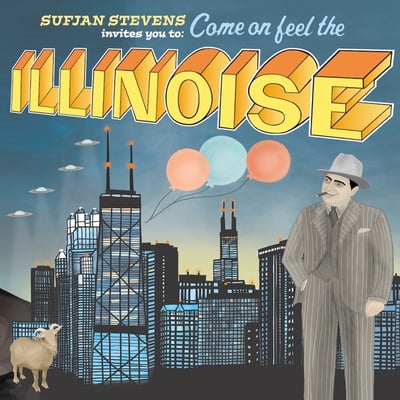
Sufjan Stevens Illinois
Released Jul 4, 2005 Asthmatic Kitty
Established consensus 19 professional reviews Updated Mar 23, 2026
Strong critical consensus
Sufjan Stevens's Illinois reads like a miniature American epic, a vividly researched, orchestrated song cycle that maps history, myth and private grief across lush chamber-pop arrangements.
How ChoruScore worksFull critic consensus
Sufjan Stevens's Illinois reads like a miniature American epic, a vividly researched, orchestrated song cycle that maps history, myth and private grief across lush chamber-pop arrangements. Critics agree the record blends playful oddities with aching intimacy, turning baroque instrumentation, choirs and brass flourishes into stories about midwestern places, religion, memory and even murder. Across 19 professional reviews the consensus score sits at 91.11/100, a signal that reviewers consistently regard Illinois as ambitious, affecting and singular in scope.
Professional reviews praise the album's ability to shift from grand orchestration to hushed confession: reviewers repeatedly cite “Chicago”, “John Wayne Gacy, Jr.” and “Casimir Pulaski Day” as standout moments where narrative detail and melodic invention meet. Critics note Stevens's eclectic instrumentation and intricate arrangements, describing sequences that veer from pastoral gentleness to choir-driven climax and back again. Many commentators highlight the interplay of playfulness and melancholy, the earnestness that risks occasional twee flourishes but ultimately pays off in genuine emotional payoff.
While a few reviews register fatigue at the album's length or theatricality, the prevailing critical narrative frames Illinois as an essential work of regional storytelling and ambitious composition. Reviewers consistently call it one of Stevens's most accomplished projects, equal parts operatic ambition and intimate songwriting. For readers searching for an Illinois review, the consensus suggests the record is both worth hearing and richly rewarding on repeated listens, its best songs emerging where history, confession and orchestral craft collide.
Get the next albums worth your time.
Critic-backed picks in one clean digest. No clutter.
What Critics Are Saying
Deep insights from 19 critics who reviewed this album

Critic's Take
Sufjan Stevens arrives with a sprawling, singular beauty on Illinois, an album that balances regional stories with tender introspection. The reviewer dwells on Stevens's ability to marry hefty themes - Christianity, local lore and personal grief - to memorable melodies, and praises the record's consistent sweep from grand designs to quiet reflection. There is a sense here that Illinois is Stevens at his most ambitious and most affecting, the sort of album whose best tracks are those that let the weight of story sit inside an irresistible tune.
Key Points
-
The album's best songs pair big, local themes with singable melodies that carry emotional weight.
-
Illinois's core strength is its consistent blend of ambitious arrangements and intimate songwriting.
Themes
Ir
Critic's Take
Sufjan Stevens sounds nothing short of audacious on Illinois, a sprawling, joyously idiosyncratic song cycle that fuses history, myth and confession in near-mythic fashion. Jocelyn Clarke's prose is breathless and admiring, calling the record "breathtaking" while marvelling at Stevens's blend of alt-rock, acoustic folk, gorgeous melodies and eclectic instrumentation. For listeners searching for the best songs on Illinois, the review foregrounds the album's emotional complexity and visceral force as the reason certain tracks stand out, praising Stevens's daring thematic range from Superman to John Wayne Gacy. The tone is unequivocally laudatory, sizing the album as a singular achievement in ambition and craft.
Key Points
-
The best songs shine because they fuse Illinois history and myth with intimate confession and vivid melodies.
-
The album's core strengths are its ambitious concept, eclectic instrumentation and emotional complexity.
Themes

Critic's Take
In an admiring, slightly ornate tone, Sufjan Stevens' Illinois is presented as an audacious, grand-scale project that rewards close listening. The reviewer celebrates the album's ambition and pan-stylistic orchestration, arguing that its mix of alt.country, brass-band flourishes and minimalist threads makes Illinois a singular achievement. The emphasis is that the album functions as a coherent, operetta-like cycle whose craft and scope mark it out as essential listening.
Key Points
-
The album's best moments come from its ambitious, operetta-like cohesion and inventive arrangements.
-
Strengths are its daring scope, historical storytelling, and pan-stylistic orchestration.

Critic's Take
In this review Jonathan Keefe writes with breezy authority that Sufjan Stevens's Illinois swaggered into the light and stands as one of the year’s most remarkable recordings. Keefe emphasizes Stevens’s dense, challenging project construction and lyrical intimacy, praising tracks like “Casimir Pulaski Day” for distilling spiritual disquiet into simple, stunning images. He admires the album’s ambitious instrumentation and structural daring, arguing that Illinois is pop-art of the highest caliber and cements Stevens as one of music’s most vital voices. The voice is admiring and analytical, noting both clever wordplay and deep, affecting songwriting as reasons why listeners seek the best songs on Illinois.
Key Points
-
The review spotlights intimate songwriting and structural ambition as reasons the best songs resonate.
-
The album’s strengths are its lyrical honesty, diverse compositions, and daring instrumentation.
Themes

NO
Critic's Take
Sufjan Stevens sounds ecstatic about Illinois, calling it mindblowingly good and praising its glorious cacophony and ambitious scope. The reviewer insists the sprawling concept and rambling titles do not feel pretentious, and notes Stevens pulls off the experiment with grace and gusto. They highlight lush arrangements - choir, strings and horns - and vivid storytelling that sketches the Prairie State. This is written in a voice that celebrates the best tracks on Illinois as part of a grand, evocative mosaic rather than isolated singles.
Key Points
-
No specific tracks could be ranked because the provided tracklist is empty, despite the reviewer discussing song moments.
-
The album’s core strengths are ambitious orchestration, vivid regional storytelling, and successful blending of diverse styles.
Themes

Critic's Take
In her vivid, detail-driven voice Amanda Petrusich presents Sufjan Stevens's Illinois as a 74-minute, baroque spectacle that makes America feel both very small and very real. She marvels at Stevens' knack for marrying rousing arrangements with heartbreaking stories, and emphasizes the album's lush orchestration and literary detail. Because the provided tracklist is empty, I cannot rank tracks from this dataset, but the review repeatedly highlights the album's emotional push-pull and orchestral ambition as reasons listeners seek the best songs on Illinois.
Key Points
-
No track-level ranking possible because the provided tracklist is empty despite the review discussing specific songs.
-
The album's strengths are its lush, baroque arrangements and emotionally detailed storytelling.
Themes
Dr
Critic's Take
On Sufjan Stevens's Illinois the best songs emerge from vivid storytelling and bold arrangements, with tracks like “John Wayne Gacy Jr” and “They Are Night Zombies!! They Are Neighbors!! They Have Come Back From The Dead! Ahhhhh!” standing out for emotional weight and inventive orchestration. The record feels orchestrated and cinematic, a sweeping tribute to place that balances intimacy - the bare, chilling confession of “John Wayne Gacy Jr” - with bombastic peaks such as “They Are Night Zombies..”. Repeated listens reveal the conviction behind the project, which is why listeners asking "best songs on Illinois" will be drawn to those emotionally direct and grandly arranged moments.
Key Points
-
The best songs are those that pair intimate storytelling with rich arrangements, exemplified by “John Wayne Gacy Jr”.
-
The album's core strength is its ambitious, orchestral narration of Illinois history and emotion.
Themes

Critic's Take
In this review Michael Metivier writes with affectionate, descriptive zeal about Sufjan Stevens's Illinois, insisting that the best songs are those that marry grand, civic ambitions with intimate feeling. He repeatedly singles out tracks that move him to tears, noting how the album balances orchestral spectacle with fragile vulnerability. The reviewer frames the best tracks as emotionally devastating and richly detailed, driven by Stevens' knack for narrative, unusual time signatures, and surprising instrumentation. For queries about the best songs on Illinois, Metivier's voice makes clear that the standout moments are the ones that provoke a public, involuntary emotional response.
Key Points
-
The best songs succeed by combining sweeping, civic-scale arrangements with intimate, affecting lyrics.
-
The album's core strengths are its emotional directness, ambitious orchestration, and evocative Illinois-specific imagery.
Themes

Critic's Take
In this delightfully idiosyncratic appraisal the reviewer frames Sufjan Stevens's Illinois as both ambitious and delicious, a sonic travelogue that reads like a Pastoral Symphony of the Prairie State. The voice is playful and admiring, stacking wry comparisons - Folk? Americana? Baroque pop? - until landing on the invented charm of "Baromelancana" to capture the record's warm eccentricity. He praises the adventurous pop songs, intricate arrangements and hypnotic circular progressions, singling out moments that approach the sublime, such as "John Wayne Gacy, Jr.", as evidence of Stevens' compositional daring. The piece closes on triumphant imagery, recommending listeners to stay on the carousel and go round and round with the album.
Key Points
-
The album's best moments combine intricate arrangements with emotional peaks that approach the sublime.
-
Core strengths are ambition, meticulous composition, and an evocative, pastoral sense of place.
Themes
Ti

Critic's Take
On Sufjan Stevens's Illinois the best songs become small spectacles, where Sufjan's flair for ornate arrangements and choir-driven climaxes pays off. The review highlights “Jacksonville” as buoyant and celebrated, and singles out “The Predatory Wasp of The Palisades” for its twinkling, wispy orchestral swell, while “Chicago” is praised for pushing the choir to absurd, weepy youthful abandon. The critic writes with exuberant imagery and conviction, presenting the best tracks on Illinois as moments where modest people and grand music meet. This voice keeps the reviewer's playful, rhapsodic tone intact while answering who the best songs on Illinois are and why they stand out. No validated tracks were identified in the review text, so tracks_ranked is empty.
Key Points
-
The best song moments are where intimate stories meet grand orchestral and choral arrangements.
-
The album's strengths are lush orchestration, choir usage, and emotionally resonant regional vignettes.
Themes

Critic's Take
Sufjan Stevens arrives with Illinois as a gargantuan, heart-wrenching collection that marries brainy research with sumptuous orchestration in the reviewer’s ecstatic, slightly cheeky tone. The piece praises the album’s ambition and fragile grace, noting its epic length and lush sound without shying from the odd fatigue that brings - the voice remains admiring and wry. The narrative emphasizes that the record feels like a masterpiece so far, propelled by storytelling, orchestral swells and impeccable melodies, making queries about the best songs on Illinois answerable by the review’s clear enthusiasm. The reviewer’s colloquial metaphors and affectionate hyperbole are preserved, delivering SEO-friendly mention of Illinois while sounding distinctly like the original critic.
Key Points
-
The best moments are those where Sufjan’s storytelling meets orchestral sweep, creating heart-wrenching melodies.
-
The album’s core strengths are ambition, meticulous research, and lush, cinematic arrangements.
Themes
Critic's Take
Sufjan Stevens treats Illinois as a curious cabinet of Americana, packing a stateful orchestra into songs that feel both vast and intimately detailed. The reviewer relishes Stevens's penchant for odd, self-explanatory mythical titles and the way he mines history and hearsay for narrative fuel. There is delight in the album's inventive instrumentation - flugelhorns, choirs and even a watering-can solo - and a persistent uplift that keeps genuine disturbance at bay. For listeners searching for the best songs on Illinois the record's storytelling and arrangement are repeatedly cited as the album's strongest assets, making its standout moments those where history and baroque pop collide.
Key Points
-
No specific track names are discussed in this review, so the best song is defined by narrative ambition and inventive arrangements.
-
The album's core strengths are ambitious, detailed orchestration and a balance of uplift with dark historical storytelling.
Themes

Critic's Take
Sufjan Stevens casts a sprawling, eccentric eye over Illinois, and James Christopher Monger writes with amused admiration for its big ambitions and theatrical earnestness. The review praises the album's mini-orchestra folk epics and newfound optimism, noting a sound that draws from classic rock and progressive folk while retaining a lo-fi charm. Monger balances critique and affection, calling Stevens sometimes a snake-oil salesman yet insisting he flips the switch to genuine humanity when it matters. For readers searching for the best songs on Illinois, the review frames the album's strengths as its narrative scope, melodic richness, and emotional payoff rather than singling out isolated tracks.
Key Points
-
The best moments arise from the album's narrative scope and orchestral folk arrangements rather than individual singles.
-
Illinois's core strengths are its ambitious concept, historical detail, and warmly earnest arrangements.
Themes

Critic's Take
In his trademark conversational and slightly bemused tone, Sufjan Stevens' Illinois is presented as an earnest, eccentric concept record that doubles as a time-travelling musical travelogue. The reviewer’s voice is admiring and wry, noting Stevens' research into Illinois history and his knack for crafting orch-pop and chamber-folk mini-epics. The piece emphasizes the album's scope and ambition, praising the soft-voiced performances and multi-instrumental arrangements as evidence that this is the one time-travelling musical travelogue you should buy. The narrative reads like a recommendation from a fan who respects the project's intellect and sweet musicality.
Key Points
-
The best song cannot be named because the provided tracklist is empty, but the reviewer praises the album's mini-epic songwriting and orchestral arrangements.
-
The album’s core strengths are its ambitious concept, detailed historical references, and lush, multi-instrumental chamber-folk production.
Themes

Critic's Take
Sufjan Stevens' Illinois remains a towering portrait of America, its myths and quiet heartbreaks, and it still feels almost impossibly generous in scope. The reviewer revels in Stevens' storytelling, calling the album a collection of short stories and praising songs like “Chicago” as among the century's best, while admiring the craft of tracks such as “John Wayne Gacy, Jr.” and “Casimir Pulaski Day”. The piece emphasizes that Illinois blends chamber-pop ambition with plainspoken, often devastating lyricism, which is why many listeners search for the best songs on Illinois and keep coming back to those central highlights. Even amid occasional accusations of twee delicacy, the review argues that Stevens' sincerity and songwriting make the album feel, perversely, just about perfect.
Key Points
-
The best songs stand out because of Stevens' combination of narrative lyricism and sweeping arrangements.
-
The album's core strengths are its sincere storytelling, ambitious arrangements, and emotional reach.
Themes

Critic's Take
Sufjan Stevens' Illinois is framed repeatedly as a sweeping, ambitious song cycle, with the reviewer singling out the grandeur of the title piece and the emotional heft of “Chicago” and “John Wayne Gacy, Jr.” as the album's high points. The piece is described in cinematic terms, its baroque arrangements and theatrical orchestration making the best tracks feel like panoramic vignettes. The critic's voice is admiring and slightly wry, noting both Stevens' cleverness and the occasions when historical detail competes with emotional immediacy. For listeners searching for the best songs on Illinois, the review recommends listening for the dramatic sweep of the title track and the gorgeous craft of “Chicago” and “John Wayne Gacy, Jr.”.
Key Points
-
The best songs are those that combine Stevens' baroque arrangements with genuine emotional weight, exemplified by “Chicago” and “John Wayne Gacy, Jr.”.
-
The album's core strengths are its ambitious orchestration, playful melodies, and a blend of historical storytelling with personal revelation.
Themes

Critic's Take
Sufjan Stevens frames Illinois as a sprawling, empathetic portrait of America, its stories moving between grief and grandeur with uncanny compositional poise. The review’s voice is admiring and analytical, marveling at how Stevens balances large thematic ambition and intimate detail while keeping a humane, everyman perspective. It emphasizes the album’s range - chamber-pop anthems, intimate folk plucks, and ambient interludes - as reasons listeners still search for the best songs on Illinois. Read as a whole, the piece presents Illinois as an essential, still-resonant set of songs that map the country’s contradictions with tenderness and scale.
Key Points
-
No single best song is extractable from the review because the critic treats the album as an interconnected portrait where range and balance are the strengths.
-
The album’s core strengths are its empathetic everyman perspective and its sonic diversity that balances intimate folk moments with grand chamber-pop arrangements.