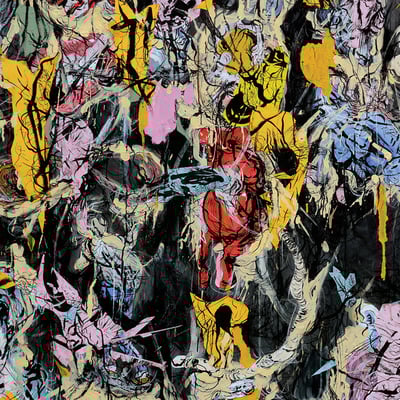
SUMAC & Moor Mother The Film
Released Apr 25, 2025 Thrill Jockey
Established consensus 9 professional reviews Updated Aug 25, 2026
Broadly positive consensus
SUMAC & Moor Mother's The Film lands as a bruising, cinematic manifesto that channels political fury into a relentless sonic score.
How ChoruScore worksCritics' Top Tracks
The songs critics returned to most
Scene 2: The Run
8 critic mentions
“The guitars blare like fire alarms on ‘Scene 2: The Run’ before resolving into a sludge bloodbath” — The Quietus
Scene 5: Breathing Fire
8 critic mentions
“Clocking in at a little longer than 16 and a half minutes, "Scene 5: Breathing Fire," rife with sludge and drag, is a leveling, multi-act treatise” — No Ripcord
Camera
8 critic mentions
“Then comes "Camera", an attempt to realize how we ended up in this hopeless wasteland.” — Beats Per Minute
Full critic consensus
SUMAC & Moor Mother's The Film lands as a bruising, cinematic manifesto that channels political fury into a relentless sonic score. Across nine professional reviews the record earned an 82.67/100 consensus score, and critics consistently point to a handful of tracks as the album's most potent moments—“Scene 2: The Run”, “Scene 5: Breathing Fire”, “Camera” and the opening “Scene 1” emerge repeatedly as focal points where anger, witness and catharsis converge. Reviewers praise Moor Mother's volcanic spoken-word and SUMAC's obliterating riffcraft for turning narrative fragments into visceral, confrontational soundscapes rather than background accompaniment.
The critical consensus emphasizes themes of surveillance, systemic violence and Afrofuturist resistance, with many critics describing the record as a time capsule of the present that uses sound as medium to bear witness. Several reviewers celebrate how tracks like “Scene 2: The Run” and “Camera” translate frantic testimony into musical apexes, while “Scene 5: Breathing Fire” functions as a devastating, cathartic finale. At the same time some critiques note a collaboration imbalance and moments of meandering in the first half of the record, arguing the album sometimes favors atmospherics and noise over fully integrated songwriting.
Taken together the professional reviews portray The Film as a demanding but essential listen: not an easy pleasure, but a genre-defying collision of metal, free-jazz improv and political poetry that rewards repeat attentive listening and holds a stark mirror to historical and contemporary violences. Below, the detailed reviews unpack why the best songs on The Film feel like both indictment and elegy, and whether the record's intensity amounts to lasting catharsis or uncompromising menace.
Track Ratings
How critics rated each track, relative to this album (0-100). Only tracks that made critics feel something are rated.
Scene 1
Scene 2: The Run
Hard Truth (feat. Candice Hoyes)
Scene 3 (feat. Kyle Kidd)
Scene 4 (feat. Sovei)
Camera
The Truth is Out There
Scene 5: Breathing Fire
Get the next albums worth your time.
Critic-backed picks in one clean digest. No clutter.
What Critics Are Saying
Deep insights from 11 critics who reviewed this album

Critic's Take
This is serious music by serious people, a thematic collage that rewards repeated listening and pins its strongest moments to those standout tracks.
Key Points
-
The album’s core strengths are Moor Mother’s fierce vocal presence, careful restraint in interplay, and a thematic collage confronting violence and media witness.
Themes

Critic's Take
Moor Mother and SUMAC make The Film feel like a scorched, narrativized score where the best songs - notably “Scene 2: The Run” and “Scene 5: Breathing Fire” - function as centerpieces of fury and structure. The reviewer revels in Ayewa’s commanding delivery and SUMAC’s colossal, muck-drenched textures, arguing that the best tracks on The Film pair spoken fury with riff-charged momentum. In this voice, the record’s high points are praised for turning chaos into purposeful indictment, with “Camera” singled out as an intense oddity that consolidates the album’s thematic thrust. Overall, the critic frames these standout scenes as the moments when narrative, noise, and protest cohere most powerfully on The Film.
Key Points
-
“Scene 5: Breathing Fire” is best for its multi-act sludge and Ayewa’s most impassioned stanzas meeting SUMAC’s doom.
-
The album’s core strengths are its fusion of political spoken-word intensity with colossal, immersive noise and narrative scoring.
Themes

Critic's Take
The reviewer foregrounds Ayewa's outraged spoken-word in “Scene 1” and the panicked, train-like tumult of “The Run” as the album's emotional center. The tone is dire but admiring, insisting this collision of post-Afrofuturistic poetry and ruinous noise amounts to one of the year’s most essential listens.
Key Points
-
The 17-minute closer "Scene 5: Breathing Fire" is the album's emotional and thematic apex.
-
The Film's core strengths are Moor Mother’s outraged spoken-word and SUMAC’s catastrophic noise arrangements, which together make the record essential.
Themes

Critic's Take
SUMAC & Moor Mother make The Film feel like an assault and a revelation at once, where the best tracks - notably “Hard Truth (feat. Candice Hoyes)” and “Camera” - distill the record's furious clarity. The reviewer's sentences push and pry, insisting that sound here is medium not image, and that moments like “The Truth is Out There” carry a brutal, pulsing logic. It praises the album's immediacy and complexity without surrendering to neat conclusions, naming particular songs as points where the collaboration's force coheres. This is an album whose best songs reward repeated, attentive listening because they make the sonic overwhelm feel purposeful and pointed.
Key Points
-
Hard Truth is best because it distills the collaboration's furious clarity into a focused, striking moment.
-
The album's core strength is its sonic immediacy and complex, overwhelming sound used as medium rather than image.
Themes

Critic's Take
Moor Mother and SUMAC make The Film feel like a scorched, cinematic manifesto where the best songs - notably “Camera” and “Scene 2: The Run” - deliver pyrotechnic fury and bleak elegy in equal measure. The reviewer revels in Moor Mother’s volcanic delivery and the band’s Sunn O))) like obliterations, arguing that “Camera” detonates with drum salvos and free jazz apocalypse energy, while “Scene 2: The Run” blares like fire alarms before collapsing into sludge. The closing 16-minute title piece is described as majestic and elegiac, a devastating finale that encapsulates the album’s post-accelerationist, Afrofuturist vision. This is an album whose best tracks are its largest gestures, the moments where Moor Mother’s poetry and SUMAC’s pyrotechnics collide to soundtrack a very present reality.
Key Points
-
The best song is the closing 16-minute epic (Scene 5 / title piece) because it magnifies Moor Mother’s despair and SUMAC’s pyrotechnic power into a majestic finale.
-
The album’s strengths are its visceral collaboration, cinematic scope, and fusion of free jazz, noise, and post-metal to reflect contemporary reality.
Themes


Critic's Take
In his measured, analytical voice Tom Piekarski argues that SUMAC & Moor Mother deliver a genuinely genre-defying statement with The Film, and he repeatedly points to best tracks such as “Scene 5: Breathing Fire” and “Scene 2: The Run” as moments where riff and rap collide to greatest effect.
Key Points
-
The best song is "Scene 5: Breathing Fire" because its vigorous riff creates a rhythmic pocket that lets Moor Mother's lyrics land with traditional hip-hop momentum.
Themes

Critic's Take
Moor Mother and SUMAC return with The Film, a noisy, militant time capsule that feels like a fuller realisation of their political fury rather than a true synthesis of styles. The reviewer's voice settles on the record's abrasive pleasures - praising “Scene 2: The Run”, “Camera” and “Scene 5: Breathing Fire” as the best tracks, spots where Moor Mother’s delivery and SUMAC’s swirling doom lock into a thrilling momentum. Overall, the reviewer urges listeners to get it while it’s hot, valuing its militancy and human noise even as it underlines the collaboration’s imbalance.
Key Points
-
The reviewer names "Scene 2: The Run" the best track for its locked-in momentum between Moor Mother and SUMAC.
-
The album’s core strengths are its political fury, militant noise, and the potent combination of Moor Mother’s delivery with SUMAC’s distortion.
Themes

Critic's Take
SUMAC & Moor Mother make something harrowing and startling on The Film, and the best songs on The Film are those where both acts lock in, especially “Scene 1” and “Scene 5: Breathing Fire”. The opener “Scene 1” lands as a knockout when Ayewa speaks plainly - you feel the shock of voice without manipulation - and the closer “Scene 5: Breathing Fire” delivers the rush when the duo run together. Tracks like “Scene 2: The Run” and “Camera” show the album’s range, from dizzying suites to clear-eyed calls to witness, making these the best tracks on The Film for their blend of fury and clarity.
Key Points
-
The best song is the opener “Scene 1” because Ayewa's unmanipulated voice lands as a knockout and frames the album's urgency.
-
The album’s core strengths are the volatile alignment between SUMAC’s heavy, experimental metal and Moor Mother’s pointed, poetic delivery.
Themes
Th
Critic's Take
SUMAC and Moor Mother make a bruising, uncompromising record with The Film, and the best songs show why this pairing works so well. The narrator's tone is intense and analytical, praising how Sumac's crushing riffs amplify Moor Mother's biting poetry, while noting the album is meant to unsettle rather than entertain.
Key Points
-
The album's core strengths are its thematic weight, abrasive instrumentation, and ability to unsettle rather than entertain.
Themes

Critic's Take
In a voice that never lets go, SUMAC & Moor Mother make The Film feel like a visceral, living soundtrack where the best tracks - “Scene 1”, “Camera” and “Scene 5: Breathing Fire” - do the heaviest lifting. Hodgson praises the album's lyricism and blistering instrumentation, noting how “Scene 1” opens with powerful vocals and vivid war imagery, how “Camera” unsettles with repeated commands of "get away", and how “Scene 5: Breathing Fire” closes with a magnificent, hard-hitting groove. The result is relentless, cathartic and unforgettable, a record that demands repeat listens to unpack its intensity and themes.
Key Points
-
The best song is "Camera" for its unsettling sampling, blast-beat intensity, and memorable vocal hook.