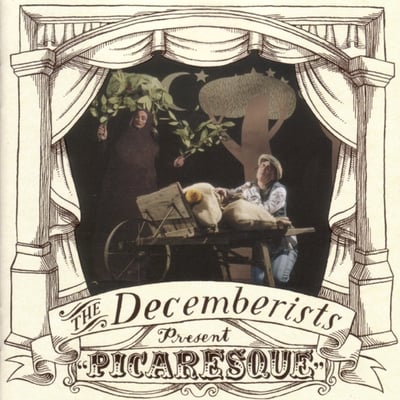
The Decemberists Picaresque
Released Mar 22, 2005 Kill Rock Stars
Established consensus 17 professional reviews Updated Aug 25, 2026
Broadly positive consensus
The Decemberists's Picaresque arrives as a theatrically minded collection of story-songs that trade conventional indie-pop for literary, maritime narratives and stageworthy arrangements.
How ChoruScore worksCritics' Top Tracks
The songs critics returned to most
The Mariner's Revenge Song
7 critic mentions
“the midsection in this song where the music effectively stops leaving female vocals gorgeously crooning about revenge” — Sputnik Music
We Both Go Down Together
1 critic mention
“heard best on the baroque pop of 'We Both Go Down Together” — Drowned In Sound
16 Military Wives
6 critic mentions
“Elsewhere, the present makes a brief appearance in 16 by 32, taking on the current war(s) and the pundits who sit by and say nothing” — No Ripcord
Full critic consensus
The Decemberists's Picaresque arrives as a theatrically minded collection of story-songs that trade conventional indie-pop for literary, maritime narratives and stageworthy arrangements. Across 17 professional reviews the record earned an 81.59/100 consensus score, and critics consistently point to a handful of showpieces as the album's emotional and musical centerpieces.
Reviewers praise the long-form ambition of “The Mariner's Revenge Song” and single-minded immediacy of “16 Military Wives”, while tracks like “On the Bus Mall”, “The Sporting Life” and “We Both Go Down Together” are repeatedly cited as standout moments—the best songs on Picaresque combine baroque folk-pop instrumentation, seafaring tableaux and sharp, often satirical narratives. Critics note the band's growing cohesion: tightened rhythms, denser arrangements and Jenny Conlee's accordion and string flourishes give many songs the heft of miniature theatrical pieces. The consensus celebrates Colin Meloy's knack for character-driven storytelling, wit and historical verisimilitude, even when his retro stylings verge on pastiche.
That said, some reviews register reservations about theatrical excess and occasional self-consciousness, suggesting ambition sometimes tips into overwrought tableau rather than songcraft. Still, across these professional reviews the tone is largely favorable: Picaresque is praised for its folk-rock invention, bold narrative scope and a string of tracks critics call among the band's best, making a strong case for those asking whether Picaresque is worth listening to. Read on for full reviews and deeper takes on the record's nautical revenge tales, political ironies and bittersweet romances.
Track Ratings
How critics rated each track, relative to this album (0-100). Only tracks that made critics feel something are rated.
The Infanta
We Both Go Down Together
Eli, the Barrow Boy
The Sporting Life
The Bagman's Gambit
From My Own True Love (Lost At Sea)
16 Military Wives
The Engine Driver
On the Bus Mall
The Mariner's Revenge Song
Of Angels and Angles
Get the next albums worth your time.
Critic-backed picks in one clean digest. No clutter.
What Critics Are Saying
Deep insights from 17 critics who reviewed this album

Critic's Take
The Decemberists treat listeners to a rollicking, character-stuffed Picaresque where the best songs - “Eli, the Barrow Boy” and “The Bagman's Gambit” - arrest attention with folky gravity and narrative wit. The tone is affectionate and astute, praising how Chris Meloy grounds baroque fancies in the personal, so these standout songs feel both comic and powerfully moving.
Key Points
-
The best song is “Eli, the Barrow Boy” for its folky, disturbed gravity and murder-ballad power.
-
The album's core strengths are literate storytelling, baroque arrangements, and the blend of comic wit with genuine emotional stakes.
Themes
Ti
En

Critic's Take
The Decemberists trade straightforward pop for theatrical storytelling on Picaresque, and the best tracks - “From My Own True Love (Lost At Sea)” and “The Mariner's Revenge Song” - show why. The review luxuriates in Colin Meloy's narratorial delivery and the instrumental touches that set mood and character, praising the deep drums under “From My Own True Love (Lost At Sea)” and Jenny Conlee's jaunty accordion on “The Mariner's Revenge Song”. The album rewards listeners seeking the best songs on Picaresque by offering vivid, scene-driven numbers rather than conventional singles. Overall, the record reads and sounds like a staged musical reading, with those two tracks standing out as exemplars of that approach.
Key Points
-
The best song is vivid and mood-setting, with “From My Own True Love (Lost At Sea)” using drums to signal foreboding.
-
The album's core strength is literary, character-driven storytelling delivered with theatrical instrumentation.
Themes
Co


Critic's Take
The Decemberists find new urgency on Picaresque, where narrative ambition gives way to sharper, more immediate songs - the best tracks on Picaresque are the wrenching “On the Bus Mall” and the incendiary “16 Military Wives”. Deusner praises the album's move away from staginess toward music that breathes, arguing that “On the Bus Mall” may be "perhaps the best song he's written" while “16 Military Wives” arrives as the record's one standout, furious and topical. These two songs, alongside the epic “The Mariner's Revenge Song”, demonstrate the band's broadened scope and heightened dynamics, making them the top songs on Picaresque in this review.
Key Points
-
The reviewer singles out "On the Bus Mall" as possibly Meloy's best song due to its evocative storytelling and lyrical contrasts.
-
Picaresque's core strengths are tighter, less-stagy songwriting, dynamic arrangements, and a newfound topical urgency.
Themes
Sp
Dr
Critic's Take
The Decemberists deliver on Picaresque with a string of best songs that underline their theatrical folk ambition. The reviewer lauds “We Both Go Down Together” for its baroque pop strings and “The Mariner's Revenge Song” as a nine minute pirate shanty, while singling out “16 Military Wives” as the album's gloriously fun indie-pop highlight. For listeners asking what the best tracks on Picaresque are, these songs encapsulate the record's humour, drama and opulent arrangements.
Key Points
-
The best song is 'We Both Go Down Together' for its baroque pop strings and soaring arrangement.
-
The album's core strengths are ambitious storytelling, theatrical arrangements, and inventive production.
Themes

Critic's Take
The Decemberists sound more focused and purposeful on Picaresque, with standout moments that prove their move toward full-band rock pays off. The reviewer repeatedly points to “The Infanta” and “The Sporting Life” as prime examples of tightened rhythms and dense instrumentation, making them two of the best songs on Picaresque. There is also praise for tracks like “On the Bus Mall” for its interplay between acoustic and electric guitars, which helps explain why fans might call these the best tracks on Picaresque. Overall the tone is celebratory yet measured, crediting Meloy's nautical storytelling while noting the band has gained serious chops.
Key Points
-
The Infanta is best because it exemplifies the band's tightened rhythms, dense layering, and newfound cohesion.
-
Picaresque's core strengths are its evolution into a more cohesive rock band and its continued knack for nautical, long-form storytelling.
Themes

Critic's Take
The Decemberists make Picaresque feel like a musical adventure, and the best songs prove it, with “16 Military Wives” standing out as a dazzling protest track and “The Mariner's Revenge Song” as a chilling sea-story centerpiece. The reviewer praises the band for reign-ing in exuberance and letting tracks such as “Eli, the Barrow Boy” breathe, creating moving, stripped-down moments alongside grander anthems like “The Bagman's Gambit”. Overall the best tracks on Picaresque combine vivid storytelling, layered instrumentation, and memorable climaxes that make this the band's finest release yet.
Key Points
-
The reviewer declares “16 Military Wives” the best song for its dazzling protest lyricism and orchestral climax.
-
The album's core strengths are storytelling lyrics, layered instrumentation, and successful shifts between stripped-down and anthemic arrangements.
Themes

Ar

Critic's Take
The Decemberists sound at their most operatic on Picaresque, and the best tracks - particularly “Eli, the Barrow Boy” and “The Mariner's Revenge Song” - show Colin Meloy turning on his inner Tom Waits and Fairport Convention to spectacular effect. The review foregrounds the album's parade of vivid parables, noting that songs like “On the Bus Mall” rend ravaged innocence while “Eli, the Barrow Boy” works the heavy labor motif into folk-rock invention. Overall, the record's theatrical imagination and frenzied walls of strum, strings and cabaret accordion make these tracks the standout moments on Picaresque.
Key Points
-
The best song moments like "The Mariner's Revenge Song" combine melodrama and narrative climax to define the album's power.
-
Picaresque's core strengths are theatrical storytelling, folk-rock invention, and vivid, parable-like songwriting.
Themes
Pr
Ir
Critic's Take
The Decemberists sound like carnival storytellers on Picaresque, full of rogues and maritime misadventure, and the best songs are the narrative showpieces. Kevin Courtney picks out Colin Meloy's knack for sharply observed tales, so tracks such as “The Mariner's Revenge Song” stand out as anthemic sea-shanties while “Eli, the Barrow Boy” and “16 Military Wives” show the band's gift for character sketches. He admires the fine tunes but warns the album sometimes feels self-consciously retro, leaving the sea-shanty to overstay its welcome. Overall, Picaresque rewards listeners who relish storytelling in song, especially on its most theatrical numbers.
Key Points
-
The best song is the theatrical “The Mariner's Revenge Song” because it epitomizes the album's dramatic sea-shanty storytelling.
Themes
