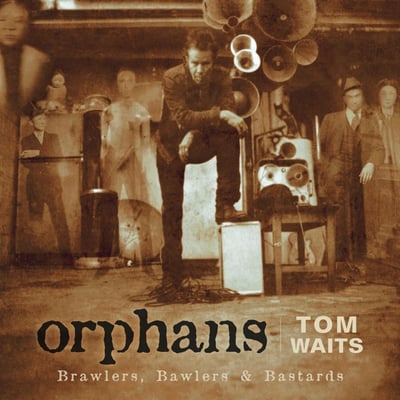
Tom Waits Orphans: Brawlers, Bawlers & Bastards
Released Nov 17, 2006 Anti/Epitaph
Established consensus 25 professional reviews Updated Mar 23, 2026
Strong critical consensus
Tom Waits's Orphans: Brawlers, Bawlers & Bastards assembles a 54-song menagerie that reads less like a leftovers package and more like a career-spanning portrait of an American eccentric.
How ChoruScore worksCritics' Top Tracks
The songs critics returned to most
Dog Door
1 critic mention
“there may be nothing else on these three discs as striking as "Dog Door” — Pitchfork
Road to Peace
11 critic mentions
“Road To Peace, a song sung from the perspective of a suicide bomber, is easily the most moving track in the entire collection” — Slant Magazine
If I Have to Go
2 critic mentions
“In "If I Have to Go" for his love to tell all the others she’ll hold in her arms that he’ll be back” — PopMatters
Full critic consensus
Tom Waits's Orphans: Brawlers, Bawlers & Bastards assembles a 54-song menagerie that reads less like a leftovers package and more like a career-spanning portrait of an American eccentric. Critics praise the set's willingness to move from bruising blues and roadhouse brawls to spare balladry and theatrical experiments, and the consensus suggests the collection succeeds as both anthology and artistic statement. Across 25 professional reviews the record earned an 89.84/100 consensus score, a signal that reviewers consistently found the box both generous and essential for Waits devotees and curious newcomers alike.
Reviewers point to specific standout tracks as keys to the set's logic. Gritty openers such as “Lie to Me” and polemics like “Road to Peace” anchor the Brawlers disc, while fragile ballads including “If I Have to Go” and “Down There By the Train” supply the Bawlers with marrow-deep melodrama; critics also single out “Bottom of the World”, “Dog Door”, and “World Keeps Turning” as recurrent highlights. Professional reviews emphasize themes of age and decay, outsiders and drifters, blues and gospel influences, and a voice-as-instrument approach that makes even the oddities feel integral rather than incidental.
While many critics celebrated the anthology's scope and rescued rarities, some acknowledged its unevenness and the inevitable filler of any odds-and-ends compilation. Even so, the prevailing critical consensus frames Orphans as a vivid retrospective that balances theatricality with intimacy, rescuing lost songs into a coherent artistic narrative. For readers searching for an Orphans: Brawlers, Bawlers & Bastards review, the quick verdict is clear: the collection is worth exploring for its standout tracks and its panoramic view of Waits' singular career.
Track Ratings
How critics rated each track, relative to this album (0-100). Only tracks that made critics feel something are rated.
Lie to Me
LowDown
2:19
Fish In the Jailhouse
Bottom of the World
Lucinda
Ain't Goin' Down to the Well
Lord I've Been Changed
Puttin' On the Dog
Road to Peace
All the Time
The Return of Jackie and Judy
Walk Away
Sea of Love
Buzz Fledderjohn
Rains On Me
Bend Down the Branches
You Can Never Hold Back Spring
Long Way Home
Widow's Grove
Little Drop of Poison
Shiny Things
World Keeps Turning
Tell It to Me
Never Let Go
Fannin Street
Little Man
It's Over
If I Have to Go
Goodnight Irene
The Fall of Troy
Take Care of All My Children
Down There By the Train
Danny Says
Jayne's Blue Wish
Young at Heart
What Keeps Mankind Alive
Children's Story
Heigh Ho
Army Ants
Books of Moses
Bone Chain
Two Sisters
First Kiss
Dog Door
Redrum
Nirvana
Home I'll Never Be
Poor Little Lamb
Altar Boy
The Pontiac
Spidey's Wild Ride
King Kong
On the Road
Dog Treat (Live)
Missing My Son
Get the next albums worth your time.
Critic-backed picks in one clean digest. No clutter.
What Critics Are Saying
Deep insights from 25 critics who reviewed this album

Critic's Take
Tom Waits’s Orphans: Brawlers, Bawlers & Bastards is at its best when it marries grit and tenderness, with the searing opener “Lie to Me” and the aching “Road to Peace” standing out. Jimmy Newlin’s ear lingers on the raw blues stomp of “Ain't Goin' Down to the Well” and the stripped, barroom shine of the Bawlers that send you back taking the long way home. The Bastards disc dares the listener with oddball pieces like “Nirvana” and spoken-word vignettes, making the collection feel less like leftovers and more like a directed museum of Waits’s experiments. For anyone searching for the best songs on Orphans: Brawlers, Bawlers & Bastards, start with “Lie to Me” and “Road to Peace” and let the rest reveal itself.
Key Points
-
“Road to Peace” is the collection’s emotional centerpiece, singled out as the most moving track and compared to his best work since Rain Dogs.
-
Orphans’s strengths are its range: raw blues and rock, intimate ballads, and daring experimental pieces that together showcase Waits’s eclectic craftsmanship.
Themes

Critic's Take
Tom Waits's Orphans: Brawlers, Bawlers & Bastards feels like a vast, unruly catalogue of American misfits, but it is in tracks such as “The Road to Peace” and “The Long Way Home” that the set's power is most concentrated. The review's tone is ardent and descriptive, guiding readers seeking the best songs on Orphans: Brawlers, Bawlers & Bastards straight to those two tracks while praising the project's adventurous sweep. This is a collection to dip into, but those looking for the best tracks on the album will find them in these vividly drawn moments.
Key Points
-
The album's core strengths are its genre-spanning breadth and Waits's singular voice, marrying roadhouse grit, heartbreaking ballads and experimental oddities.
Themes
En
En
Critic's Take
Tom Waits remains the musical equivalent of Marmite, and Orphans: Brawlers, Bawlers & Bastards rewards those who savour his eclectic palette. The reviewer singles out the Brawlers disc as the pick, praising its raucous psychobilly and grungey blues, and highlights “Road to Peace” as a stinging, moral indictment that marks it among the best songs on the album. At the same time the tenderness of “Little Drop of Poison” is invoked to show why the Bawlers disc is indispensable. The triple-CD feels less like three separate beasts and more like a unified feast of vivid flavours, making the best tracks on Orphans: Brawlers, Bawlers & Bastards both varied and complementary.
Key Points
-
The best song, “Road to Peace”, stands out for its moral urgency and Brawlers' raucous energy.
-
The album's core strengths are eclectic instrumentation, genre-spanning arrangements, and vivid, often cinematic songwriting.
Themes
NO
Critic's Take
In his idiosyncratic, conversational way the reviewer celebrates Tom Waits and the sprawling Orphans: Brawlers, Bawlers & Bastards, singling out “Home I'll Never Be” and “Spidey's Wild Ride” as striking moments. The critic frames these best tracks as emblematic of Waits's restless experiments and emotional center, and argues the compilation's breadth proves he remains provocatively inventive. The tone is admiring but precise, pointing to specific songs as reasons why these are the best tracks on Orphans: Brawlers, Bawlers & Bastards.
Key Points
-
The best song, “Home I'll Never Be”, is the most personally revealing and emotionally potent track.
-
The album's strengths are its wide-ranging experimentation, emotional depth, and willingness to tackle political and stylistic extremes.
Themes
En

Critic's Take
The review revels in the record's tonal unity, noting how even covers such as “The Return Of Jackie And Judy” take on his musical character, while originals like “Road To Peace” supply rare, furious political fire. These highlights show why listeners searching for the best tracks on Orphans will find both tender ballads and raucous brawlers that define Waits' strange genius. The collection is generous, sometimes brutal, always human, making the standout songs feel inevitable rather than assembled.
Key Points
-
The album's core strength is its seamless melding of ballad, blues and bizarre experiments into a unified, humane vision.
Themes
NO

Critic's Take
Tom Waits never settles, and on Orphans: Brawlers, Bawlers & Bastards the best tracks underline that restless genius. The reviewer singles out “Nirvana” as a spoken-word vision of paradise you can never stay in, and crowns “Fannin Street” and “World Keeps Turning” among the album's true standouts for turning local myth and elegy into something vast. There is sorrow, but also rescue: “Lord I've Been Changed” and “Down There By The Train” offer hints of redemption amid the drift. Read together, these songs show why the best songs on Orphans feel like fragments of a whole career, ragged and radiant in equal measure.
Key Points
-
The best song, "Fannin Street", stands out for its transformation of a local spot into a timeless tragedy.
-
The album's core strength is its emotional range: transience, loss, and occasional redemption bind the three discs into a coherent career statement.
Themes

Critic's Take
Tom Waits's Orphans: Brawlers, Bawlers & Bastards is presented here as a kind of magnified miracle, and the best songs - notably “Bend Down the Branches” and “If I Have to Go” - show why. Jeff Vrabel's voice revels in the collection's mix of beauty and horror, praising marrow-deep melodies even as he delights in Waits' ghastly theatrics. He points out the mournful mastery of the Bawlers and the bruising rock of the Brawlers, and he singles out the initially unrecognizable cover “Sea of Love” and the roaring “LowDown” as clear highlights. The review reads like a primer and a recommendation: this three-disc set is magnificence in creative packaging, and these standout tracks are why listeners searching for the best songs on Orphans: Brawlers, Bawlers & Bastards should start here.
Key Points
-
The best song is emotive and concise - "Bend Down the Branches" encapsulates the Bawlers' mournful power.
-
The album's core strength is its uncanny blend of beauty and horror across three well-organized discs.
Themes

Critic's Take
Tom Waits has always been a journeyman of bent song and sound, and on Orphans: Brawlers, Bawlers & Bastards he revels in that breadth. Disc One's bravado - the rockabilly swagger of “Sea of Love” and the hobo balladry of “Bottom of the World” - stakes out the best tracks as gritty, theatrical showpieces. Disc Two supplies the tender high points, where “Never Let Go” and “You Can Never Hold Back Spring” reveal Waits' capacity for gorgeous restraint. The box is unwieldy, but these standout songs prove why the collection matters, because his voice drags past and present into something utterly new.
Key Points
-
The best song moments combine theatrical roots rock and elegiac balladry, as in "Bottom of the World".
Themes
Pr

Critic's Take
In his ornery, exact voice the reviewer makes clear that Tom Waits's Orphans: Brawlers, Bawlers & Bastards is a triumph of sonic sorting - the box set shows how Waits turns his gravelly instrument to different ends. The best songs here, like "Shiny Things" and "Buzz Fledderjohn", demonstrate the record's range: aching croons that ache with regret and ragged brawlers that rumble with gutter poetry. The reviewer lingers on "Down There By the Train" as a centerpiece, calling Waits' own piano-and-vocal demo incomparable and suffused with desperation. Overall the critique argues that, despite some filler, more than a dozen tracks rank with his finest work, because the set finally makes you hear Waits' music, not just his words.
Key Points
-
The best song, "Down There By the Train", is the emotional centerpiece because Waits' demo is described as incomparable and desperate.
-
The album's core strength is its curated sonic variety, showcasing Waits' voice as instrument across brawling, bawling and bastard forms.
Themes
Pu
Critic's Take
Tom Waits piles together a wild menagerie on Orphans: Brawlers, Bawlers & Bastards, and the best tracks make the case for his restless genius. The bruising opener “Lie to Me” sets a pounding template, while the Bawlers standout “You Can Never Hold Back Spring” is heartbreak made to be replayed until broken. Oddball reinterpretations like “The Return of Jackie and Judy” and “Danny Says” show Waits turning covers into new truths, and the sprawling “Road to Peace” proves his heft when he aims at something weighty and political.
Key Points
-
You Can Never Hold Back Spring is singled out as the emotional centerpiece with replay-ability.
-
The album's core strengths are inventive reinterpretations, cohesive rough production, and fearless experimentation.
Themes
Co
Co
Critic's Take
I keep circling back to how Tom Waits shapes his myth on Orphans: Brawlers, Bawlers & Bastards, and the best tracks - like “Fish In the Jailhouse” and “Bottom of the World” - prove why this sprawling set works. The record hums with theatrical, bruised humanity, the Brawlers riffing and the Bawlers slowing the pace into elegy, which is precisely where those two songs land spectacularly. It is a celebration of trope and singularity, a primer for new listeners and a banquet for longtime fans, showing Waits as character more than caricature. The collection’s scale lets moments of glory breathe, and these standout songs crystallize the album’s uneasy, tender power.
Key Points
-
“Fish In the Jailhouse” stands out for its braggart swagger and visceral tinpan-alley shuffle.
-
The album’s core strength is its breadth: a three-disc survey that balances theatrical grit, narrative storytelling, and affectionate reworking of Waits’ persona.
Themes

Critic's Take
Tom Waits's Orphans: Brawlers, Bawlers & Bastards reads like a boxed testament to his range, with the reviewer repeatedly pointing to the grit of “Lie to Me” and the strange allure of “Dog Door” as emblematic high points. The piece praises Brawlers' dirt-grit production that keeps the Big Bopper warble of “Lie to Me” alive, while celebrating Bastards' theatrical experiments epitomized by “Dog Door”. Mitchum's voice is admiring and slightly bemused, framing these best tracks as proof that Waits can place new sounds next to old without sounding disjointed. The result answers queries about the best songs on Orphans: Brawlers, Bawlers & Bastards by highlighting those two tracks as essential listening for understanding the set's strengths.
Key Points
-
The best song is "Dog Door" because it updates Waits' familiar devices into a thrilling, modern soundscape.
-
The album's core strengths are its stylistic compartmentalization and its proof of Waits' longevity and versatility.
Themes
Ti
Critic's Take
Tom Waits sounds at once familiar and surprising on Orphans: Brawlers, Bawlers & Bastards, and the best tracks underline that tension. The sly, ballsy honky-tonk of “LowDown” leaps out as one of the best tracks on Orphans, a reminder of the rough-edged bluesman at his most invigorating. Equally compelling is “Down There By The Train”, a heatbroken ballad that shows why the album's ballady side matters. The three-disc format means the best songs are moments of rediscovery, fun and melancholy balanced across the set.
Key Points
-
The best song moments, like “LowDown”, succeed by recapturing Waits' raw honky-tonk energy.
-
Orphans' core strength is its variety and moments of rediscovery across three discs.
Themes
Ti
Sp
Critic's Take
Tom Waits packs Orphans: Brawlers, Bawlers & Bastards with such labyrinthine charm that the best tracks - like “Road to Peace” and “Lie to Me” - feel like found relics from his many selves. Aaron Burgess writes with affectionate authority, pointing out how the three-CD structure moves from gritty Brawlers to tender Bawlers to jagged Bastards, and he treats those standout songs as keystones rather than anomalies. The result answers the search for the best songs on Orphans: Brawlers, Bawlers & Bastards by offering variety and character across a 54-song safehouse. Fans hunting the best tracks on Orphans: Brawlers, Bawlers & Bastards will find that the set rewards deep listening rather than casual skimming.
Key Points
-
The best song moments, exemplified by "Road to Peace", serve as keystones in the three-part anthology.
-
The album's strength is its breadth: stylistic range and eccentric characters reward devoted listening.
Themes
Critic's Take
Tom Waits’ three-disc Orphans: Brawlers, Bawlers & Bastards is presented as a career-spanning trove, and the review singles out the heart of the set in tracks like “If I Have to Go” and “Road to Peace”. The writer savours the extravagantly sentimental ballads on Bawlers, calling “If I Have to Go” a broken beauty that feels eternally lodged in a gaslit, fantasy America behind the bar mirror. Brawlers is praised for its rock, blues and gospel bite, with “Road to Peace” noted as a curious, topical piece. Bastards is celebrated for Waits growling, barking and gleeful improvisation, which cements these as some of the best tracks and turns on the album.
Key Points
-
The best song is “If I Have to Go” because it is described as an extravagantly sentimental, broken beauty that feels timeless.
-
The album's core strengths are its enormous variety and the successful pairing of balladry, blues/gospel grit and freewheeling experimentation.
Themes

Critic's Take
Robert Christgau hears a definitive three-CD set in Orphans: Brawlers, Bawlers & Bastards, praising how Brawlers channels Waits' blues while Bawlers houses his sentimental core. Christgau also lauds the weirdness of Bastards, calling pieces like “The Pontiac” and “Army Ants” long overdue for anyone who loves Waits' monologues. The result reads as a rare odds-and-sods project that ends up feeling definitive, making these the best tracks on Orphans: Brawlers, Bawlers & Bastards for both fans and newcomers.
Key Points
-
Christgau deems tracks like “Bottom of the World” and “LowDown” the best for their memorable instrumentation and energy.
-
The album’s core strength is its genre-spanning assembly of outtakes, new songs and spoken-word pieces that cohere into a definitive set.
Themes
Am
Critic's Take
There is a jaunty, rueful logic to Tom Waits's Orphans: Brawlers, Bawlers & Bastards, and the best songs here are the ones that feel rescued rather than repackaged. The aching “Bottom of the World” stands out as perhaps the album's most poignant tribute to hobo life, while the broken-down gospel of “Lord I’ve Been Changed” and the unflinching “Road to Peace” puncture the Brawlers disc with necessary variety. If you search for the best tracks on Orphans: Brawlers, Bawlers & Bastards, those three repeatedly surface for their vivid imagery, moral bluntness, and emotional weight. The collection reads like a master's sketchbook, full of rescued gems that reaffirm Waits' singularity.
Key Points
-
“Bottom of the World” is the best song for its vivid, poignant tribute to hobo life.
-
The album’s core strengths are its eclecticism and the rescue of strong, varied songs from obscurity.
Themes

Critic's Take
Tom Waits’s Orphans: Brawlers, Bawlers & Bastards still reads like a masterpiece, and the reissue’s addition of six new bonus cuts only deepens that sense of abundance. The review highlights the set as a three-disc compilation of new and rare songs, so the best tracks on Orphans: Brawlers, Bawlers & Bastards are implied to be those rare, revelatory moments that made the original release feel essential. The tone is celebratory and archival, noting the deluxe packaging and expanded sequence as reasons fans will revisit the best songs on the album. Mention of the vinyl reissue and deluxe booklet frames these standout moments as rediscoveries rather than a rewrite of the originals.
Key Points
-
The best songs are presented as rare, revelatory moments that made the original release feel essential.
-
The album’s core strengths are its archival depth, the quality of rare material, and the appeal of expanded packaging.