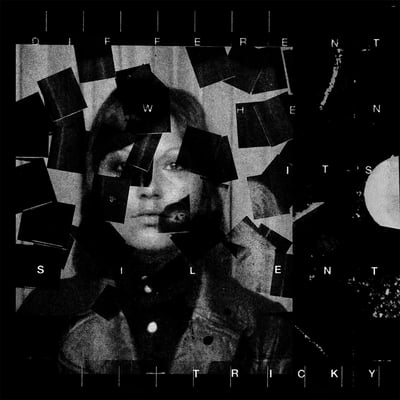
Tricky Different When It's Silent
Released Jul 17, 2026 False Idols
Established consensus 7 professional reviews Updated Oct 3, 2026
Mostly positive consensus
Tricky's Different When It's Silent arrives as a nocturnal, grief-soaked record that trades broad reinvention for austere refinement.
How ChoruScore worksCritics' Top Tracks
The songs critics returned to most
Paris Maybe (feat. rennie)
1 critic mention
Out of Place
4 critic mentions
“the closer "Out of Place" turns out to be a sort of a summary of all of the above” — Beats Per Minute
I Still See Me There
4 critic mentions
“the brooding, burning "I’m Yours" and "I Still See Me There," a 7/8 crawl through a desert of pure sadness” — Pitchfork
Full critic consensus
Tricky's Different When It's Silent arrives as a nocturnal, grief-soaked record that trades broad reinvention for austere refinement. Across seven professional reviews the consensus score sits at 71.29/100, and critics repeatedly point to a handful of slow-burn songs where brooding atmosphere, lo-fi guitar and post-punk sonics coalesce. The opening “I Still See Me There” and the repeatedly praised “Out of Place” emerge as emotional anchors, while “Be Still in the Pain” and “Paris Maybe (feat. rennie)” are singled out as standout tracks that balance melody with menace.
Professional reviews note a record built on silence and space, where vocal placement and sparse arrangements amplify themes of loss, parental grief and memory. Several critics praise the first half's live drums and guitars for delivering urgency and catharsis, and they credit Tricky's restraint for letting haunted vocals and bleak instrumentals breathe. At the same time reviewers acknowledge stylistic unevenness: collaborative singers sometimes obscure Tricky's presence, and later experimental passages feel awkward to some ears. That tension between continuity and reinvention is central to the critical consensus.
Taken together the professional reviews frame Different When It's Silent as a late-career work of atmosphere and vulnerability rather than a dramatic course correction. For readers searching for the best songs on Different When It's Silent, critics consistently point to “Out of Place”, “I Still See Me There” and “Be Still in the Pain” as the record's most affecting moments; for those weighing whether the record is worth exploring, the 71.29 consensus score across seven reviews suggests a solid, if occasionally uneven, addition to Tricky's catalogue.
Track Ratings
How critics rated each track, relative to this album (0-100). Only tracks that made critics feel something are rated.
I Still See Me There
I'm Yours
Be Still in the Pain
I Tried
So Cold
Paris Maybe (feat. rennie)
Cannon Fodder
Because I Don’t Know
Marinade
Radana
Piano
Frontier Town
Hengrove Blues
Out of Place
Get the next albums worth your time.
Critic-backed picks in one clean digest. No clutter.
What Critics Are Saying
Deep insights from 7 critics who reviewed this album
mu
Re
Critic's Take
In a voice that feels both wounded and wary, Tricky shapes Different When It's Silent around fragile, bruised performances. The opener “I Still See Me There” sets the tone with a PJ Harvey-tinged, fuzzed-up guitar and Mitch Sanders's haunted falsetto, and songs like “I Tried” and “So Cold” continue that vulnerable, threatening mood. The record's best tracks are its slow-burn moments - those where the lo-fi amp and barely-there growls about pain coalesce into real atmosphere. This is an album of restraint, where understatement becomes the strongest statement, and the best songs prove that silence can be, paradoxically, the loudest thing.
Key Points
-
The best song is the opener because it immediately establishes the album’s haunted, PJ Harvey-like tone.
-
The album’s core strength is its restrained, vulnerable atmosphere built from lo-fi guitar and muted vocal growls.
Themes

Critic's Take
Tricky sounds quietly insistent on Different When It's Silent, and the best tracks — notably “Cannon Fodder” and “Out of Place” — show why he still matters. The reviewer's voice lingers on how Tricky balances electronics and acoustic touches, praising songs like “Piano” and “Because I Don’t Know” for their spaciousness and restraint. There is a recurrent sense of reconfirmation rather than reinvention, but that restraint is deliberate, giving the best songs room to breathe. This is an album where subtlety becomes strength, and the best tracks pay off in long, patient returns.
Key Points
-
The closer "Out of Place" best summarizes the album's themes and confirms Tricky still matters.
-
The album's core strengths are its balance of electronics and acoustic instruments, and its use of space and restraint.
Themes

Critic's Take
Tricky's Different When It’s Silent is at its best on brooding, desolate songs where grief gives songs their gravity. Ben Cardew singles out “Out of Place” as one of Tricky's best songs in years, and he highlights “I’m Yours” and “I Still See Me There” as carrying the album's parental sorrow. The record's first half, with live drums and guitars, often holds up better than the awkward experiments later on, and the album's urgency and catharsis make these the best tracks on Different When It’s Silent. Cardew's tone is measured but emphatic, framing these songs as the emotional centerpieces that justify the record's unevenness.
Key Points
-
The best song, "Out of Place", is praised as one of Tricky's best in years for its venom and thundering production.
-
The album's core strengths are its emotional catharsis around parental grief and the brooding, guitar-driven first half.
Themes

Critic's Take
Tricky on Different When It's Silent is at his most agile, twisting post-punk sonics into something dark, melodic and naturally quite sexy. The review leans on highlights like “Paris Maybe (feat. rennie)”, naming it among the album's standout moments, while celebrating how Mitch Sanders adds a little sugar to the grit. The critic frames the record as taut and exhilarating, a late-career quickshot reminder of Tricky's unique talent, and positions those best songs as where nostalgia and freshness collide. In short, the best tracks on Different When It's Silent are where mood and melody meet, with “Paris Maybe (feat. rennie)” leading the pack.
Key Points
-
The best song, “Paris Maybe (feat. rennie)”, is singled out as a highlight blending post-punk and modern indie.
-
The album's core strengths are its nocturnal atmosphere, taut production and the contrast of gritty tone with melodic sugar.
Themes

Critic's Take
The opening “I Still See Me There” revisits old refrains with that bruised lyricism, while “Out of Place” reconnects with the emotional grammar of his greatest records and feels like the album's most affecting moment. Mid-album pieces such as “Cannon Fodder” and “Because I Don’t Know” trade in bleak minimalism and uncanny echoes, which together explain why fans will be asking what the best songs on Different When It's Silent are and why they matter to Tricky's late-career concerns.
Key Points
-
The best song is "Out of Place" because it reconnects Tricky with his past while offering the album's clearest moment of reconciliation.
-
The album's strengths are its ghostlike collaborations, recurring themes of loss and memory, and striking minimalism that foregrounds guest voices.
Themes

Critic's Take
The reviewist’s frustration is plain: on Different When It’s Silent Tricky often cedes the spotlight, yet the best songs still glint through. He praises “Be Still in the Pain” for its buzzing bassline and “Cannon Fodder” for its ghostly organ, arguing these are among the best tracks on Different When It's Silent because the instrumentals recall his most daring moments. He also notes Tricky reappears strongest on “I Still See Me There” and the closer “Out of Place”, moments where his haunted voice actually leads. The result feels uneven, brilliant in sound but compromised by collaborators who frequently bury the named artist.
Key Points
-
The album's core strength is its evocative, 90s-tinged production, though excessive foregrounding of collaborators undermines Tricky's presence.