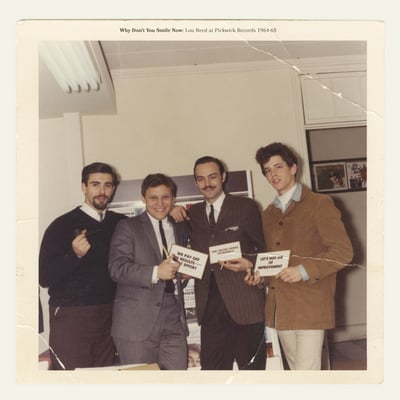
Various Artists Why Don't You Smile Now: Lou Reed at Pickwick Records 1964-1965
Released Sep 27, 2024 Light in the Attic
Early read 1 professional review Updated Jan 1, 2026
Broadly positive consensus
Early read based on 1 professional reviews. Various Artists's Why Don't You Smile Now: Lou Reed at Pickwick Records 1964-1965 reopens an overlooked chapter of Lou Reed's early career with a scrappy, revealing collection that critics say maps the proto-Velvets sparks beneath his later work.
How ChoruScore worksCritics' Top Tracks
The songs critics returned to most
The Ostrich
1 critic mention
“The Ostrich, the most notorious of Reed’s Pickwick artefacts” — Mojo
You're Driving Me Insane
1 critic mention
“You’re Driving Me Insane, a Soundsville! burner supposedly by The Roughnecks” — Mojo
Soul City
1 critic mention
“The Hi-Lifes’ Soul City, an early hard-driving spin on the party and salvation” — Mojo
Full critic consensus
Various Artists's Why Don't You Smile Now: Lou Reed at Pickwick Records 1964-1965 reopens an overlooked chapter of Lou Reed's early career with a scrappy, revealing collection that critics say maps the proto-Velvets sparks beneath his later work. Mojo's appraisal frames the compilation as both playful and instructive, arguing that cuts like “The Ostrich” and “You’re Driving Me Insane” emerge as the record's clearest signposts toward Reed's future persona and sonic experiments.
Across professional reviews the record earned an 80/100 consensus score from one review, with critics consistently noting the set's playful raggedness and assembly-line pop production as defining features. Reviewers praised standout tracks “The Ostrich”, “You’re Driving Me Insane” and “Soul City” for capturing Reed's early risk-taking, while songs such as “Oh No Don’t Do It” and “Why Don’t You Smile” underline the collection's blend of charm and labored craft.
While opinions temper full canonical re-evaluation, the critical consensus positions Why Don't You Smile Now as essential context for those tracing Lou Reed's origins: a document of proto-Velvets motifs, ragged humor and adolescent experimentation that helps explain how later, more celebrated works took shape. For listeners curious whether Why Don't You Smile Now is worth hearing, the review suggests its best tracks are both historically revealing and enjoyably rough-hewn.
Track Ratings
How critics rated each track, relative to this album (0-100). Only tracks that made critics feel something are rated.
The Ostrich (Remastered 2024)
Cycle Annie
I'm Gonna Fight
Soul City
Oh No Don't Do It
Love Can Make You Cry
Teardrop In The Sand
You're Driving Me Insane
Sneaky Pete
Wild One
Really - Really - Really - Really - Really - Really Love
Soul City
Ya Running, But I'll Getcha
We Got Trouble
Why Don't You Smile
Johnny Won't Surf No More
Tell Mamma Not to Cry
Maybe Tomorrow
Flowers For The Lady
This Rose
Surfin'
Little Deuce Coupe
Sad, Lonely Orphan Boy
I've Got a Tiger in My Tank
What About Me
Get the next albums worth your time.
Critic-backed picks in one clean digest. No clutter.
What Critics Are Saying
Deep insights from 2 critics who reviewed this album

Critic's Take
David Fricke writes with relish, calling the set a corrective to dismissal and celebrating its ragged fun and laborious craft, placing those standout moments as the embryonic sparks for Reed’s later genius. The review pitches this collection as essential listening for anyone asking what the best tracks on Why Don't You Smile Now reveal about Reed’s restless, persona-trying phase.
Key Points
-
The album’s core strength is revealing Reed’s formative labor and playful, ragged experiments that illuminate his evolution.
Themes
