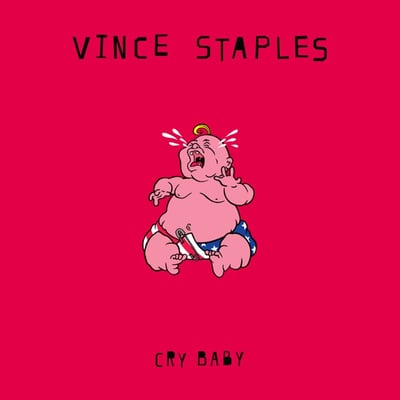
Vince Staples Cry Baby
Released Jun 5, 2026 Loma Vista Recordings
Established consensus 8 professional reviews Updated Oct 1, 2026
Broadly positive consensus
Vince Staples's Cry Baby lands as a bracing, genre-bending statement that trades inward reflection for a widescreen political gaze, and critics largely agree it succeeds.
How ChoruScore worksCritics' Top Tracks
The songs critics returned to most
Blackberry Marmalade
5 critic mentions
“Sonically, the song is tense and tightly-wound, fuzzy guitars and propulsive drums carrying the track to furious heights.” — Consequence
The Running Man
5 critic mentions
“The Running Man,” a growling, rambunctious track that will sound incredible live, is Vince’s opportunity to mix his goals of addressing his people” — Consequence
Only In America
2 critic mentions
“Take ‘Only In America’, where he uses both soul and a sense of sonic urgency to mirror his lyrics” — DIY Magazine
Full critic consensus
Vince Staples's Cry Baby lands as a bracing, genre-bending statement that trades inward reflection for a widescreen political gaze, and critics largely agree it succeeds. Across eight professional reviews the record earned an 83.75/100 consensus score, with reviewers singling out guitar-driven production, punk energy, and live-band momentum as the engines behind its urgency. The opener “Blackberry Marmalade” repeatedly emerges as a standout, its drumline bounce and tense guitars described as sugar coating a bitter medicine.
Reviewers consistently praise tracks that pair blunt social critique with immediate musical payoff. “The Running Man” surfaces across reviews as a visceral highlight for its chant-like fury and quickfire anxiety, while “Go! Go! Gorilla”, “Do You Know The Devil”, and “Only In America” are noted for their moral clarity and vocal versatility. Critics point to recurring themes - political critique, systemic racism, religion and faith imagery, and reclamation of rock - and credit Staples' sharper focus and reshaped sonic palette for making the album feel both urgent and cohesive.
Not all commentary is unreserved; some reviewers view the stylistic reinvention as deliberately abrasive, questioning whether fury sometimes overwhelms nuance. Yet the majority frame Cry Baby as a renewal in Staples' catalog: a record of renewed energy that turns protest into propulsive songs and places several tracks among his most compelling work. For readers searching for a Cry Baby review, the consensus suggests the record is worth listening to for its standout songs and its fierce, clear-eyed critique of contemporary America.
Track Ratings
How critics rated each track, relative to this album (0-100). Only tracks that made critics feel something are rated.
Blackberry Marmalade
Go! Go! Gorilla
White Flag
The Running Man
TV Guide
The Big Bad Wolf
Only In America
Do You Know The Devil
Cotton
7 In The Morning
Get the next albums worth your time.
Critic-backed picks in one clean digest. No clutter.
What Critics Are Saying
Deep insights from 12 critics who reviewed this album

Critic's Take
Vince Staples arrives at a startling clarity on Cry Baby, where the best tracks like “Only In America” and “The Running Man” distill his strengths into visceral, precise statements. Morgan writes with admiration for how beats and lyrics dovetail, praising the soul and urgency of “Only In America” and the quickfire anxiety of “The Running Man” as emblematic of the album's power. The reviewer's prose balances measured analysis with superlative praise, arguing that these best songs on Cry Baby showcase Vince's sharper focus and emotional range. Ultimately the critic frames the album - and its standout tracks - as both musically bold and lyrically piercing, making clear why listeners ask about the best songs on Cry Baby.
Key Points
-
The best song is “Only In America” because its soul and urgency perfectly fuse personal and political imagery.
-
The album's core strengths are its focused production and piercing, insight-filled lyrics that balance clarity with emotional depth.
Themes

Critic's Take
Vince Staples leans hard into religious iconography on Cry Baby, turning faith into a lens for American rot while delivering some of his sharpest blasts. The reviewer's voice lingers on the urgency of “Blackberry Marmalade”, its tense guitars and propulsive drums carrying Staples' fury, and the eerie faith-wrestling of “Do You Know The Devil” as a thematic centerpiece. Tracks like “The Running Man” and “The Big Bad Wolf” are called out for their direct appeals to Black listeners and live-ready intensity, making them among the best tracks on Cry Baby. The critic frames these songs as both mirror and rallying cry, praising their propulsion and moral clarity rather than mere flash.
Key Points
-
“Blackberry Marmalade” is the best song for its tense production and fervent delivery that encapsulate the album’s purpose.
-
The album’s core strengths are its use of religious imagery and direct appeals to the Black community as a call-to-action.
Themes

Critic's Take
of Montreal's aethermead finds Kevin Barnes leaning into more organic, vulnerable, psychedelic territory while still serving up earworm moments. Reed's tone is admiring and precise, noting how the album's consistency makes those best songs stand out more sharply. For listeners searching for the best tracks on aethermead, these three cuts emerge as the clearest high points in Barnes's shapeshifting palette.
Key Points
-
The album’s core strengths are organic, consistent songwriting and a psychedelic, vulnerable tone that spotlights focused band arrangements.
Themes

Critic's Take
Vince Staples channels a compressed, punkish fury on Cry Baby, and the best tracks - “White Flag” and “Blackberry Marmalade” - are where his political gaze lands hardest. Garratt-Stanley revels in Staples' relish for newfound independence, pointing to the video-led power of “White Flag” and the blunt, cinematic critique in “Blackberry Marmalade”. The album’s rough, crunchy sonics let songs like “The Big Bad Wolf” flirt with swagger while still delivering structural muscle. Overall, the record’s standout moments make clear why listeners asking for the best songs on Cry Baby should start with those tracks and work outward.
Key Points
-
The best song is “White Flag” because its video and lyricism crystallise the album’s political power.
-
The album’s core strengths are its punkish, compressed sonics and candid, politically charged storytelling.
Themes

Critic's Take
Vince Staples sounds thrillingly unmoored on Cry Baby, a record where guitars push immediacy and the best tracks burn brightest. Go! Gorilla” and the caustic punk fury of “The Running Man” emerge as the best songs on Cry Baby for their visceral urgency and lyrical bite. Elsewhere, “The Big Bad Wolf” and “Only In America” deepen the album's darkness, making the record feel cohesive, potent, and immediately arresting. This is an album that demands patience, but rewards it with subversive, complex takes on American life in 2026.
Key Points
-
The pounding opener “Blackberry Marmalade” is the album's strongest track for its relentless imagery and tone-setting power.
-
Cry Baby's core strengths are guitar-driven immediacy, lyrical complexity, and cohesive, subversive social critique.
Themes
Th
Critic's Take
Vince Staples refuses to let the old binaries stick on Cry Baby, and the record rides that friction with sly intelligence. The reviewer skewers the myth that protest equals worth, and positions the album as proof that anger and fun are not mutually exclusive. For listeners asking what the best songs on Cry Baby are, the review implies the standout moments are those that balance political bite with musical pleasure. The tone is impatient with received opinion, and that impatience is what makes the case for the album's sharpest tracks.
Key Points
-
The best songs are implied to be those that combine political bite with musical enjoyment.
-
The album's core strength is refusing the false dichotomy between protest credibility and fun.
Themes

Critic's Take
Vince Staples leans outward on Cry Baby, trading inward reflection for a blunt, politically furious gaze that makes the best songs hit like manifestos. The best tracks on Cry Baby, notably “Cotton” and “Blackberry Marmalade”, pair dense, allegorical lyricism with live rock textures so Staples's voice stays centre stage. “Go! Go! Gorilla” and “The Big Bad Wolf” stand out as direct meditations on police brutality, their questions and scenario-building sharpening the record's moral urgency. The result is a daring, uncompromising LP where the strongest songs double as social argument and artistic reinvention.
Key Points
-
The best song, "Cotton", is praised for its layered allegory and dense exploration of Black trauma.
-
The album's core strengths are its political urgency, vocal-forward songwriting, and smart use of live rock/post-punk instrumentation.
Themes

Critic's Take
Vince Staples leans into full-band energy on Cry Baby, and the reviewer hears the payoff in songs like “The Running Man” and “Do You Know The Devil”. The writing notes how the live instrumentals push Staples out of his usual world-weary distance, forcing him to keep tempo with the players and yielding some of the best tracks on Cry Baby. The Slick Rick-sampling “The Big Bad Wolf” is singled out for putting his dexterity to the test over one of the album's best grooves, while opener “Blackberry Marmalade” frames his conscious lyrics with driving riffs. Overall, the new approach feels fresh and revitalising, another string to Staples' bow rather than a retreat.
Key Points
-
Cry Baby's core strength is its live-instrument momentum that pushes Staples into more immediate, energetic performances without losing his conscious lyricism.
Themes

Critic's Take
Vince Staples makes a brash, urgent case on Cry Baby, and the best songs on Cry Baby underline that plea. The opener “Blackberry Marmalade” works as sugar to the medicine, its drumline bounce and guitar buzz both defiant and horrifying. The blunt, historically wide-angled “Go! Go! Gorilla” is one of the album's clearest best tracks, tumbling out the legacy of redlining, mass incarceration, and civil-rights struggle with rare economy. Elsewhere, “Cotton” and “The Running Man” sharpen critiques of capitalism, keeping the record focused and trenchant.
Key Points
-
“Go! Go! Gorilla” is best for its compressed, sweeping history lesson and indictment of policing.
-
Cry Baby’s core strengths are its muscular rock production and focused socioeconomic critique.
Themes

Key Points
-
The album’s core strengths are its muted soft-pop textures and Horan’s laid-back vocal delivery, which suit reflective, elegiac moments.
Themes
Ok
Critic's Take
Vince Staples leans into punk-adjacent fury on Cry Baby, and the best tracks show why the genre-bending works. The visceral, chant-and-shout energy of “The Running Man” and the sing-song resignation of “Go! Go! Gorilla” make for the clearest best songs on Cry Baby, songs that turn systemic critique into immediate feeling. This is the kind of record where vocal control and abrupt couplets are functional, not fashionable, and those tracks prove it. Overall, the album’s strength is form following function, which is why the best tracks here land so convincingly.
Key Points
-
“The Running Man” is the best song because its abrupt, shouted couplets turn exasperation into anthemic force.
-
The album’s core strength is purposeful genre-bending and vocal control used to examine police brutality and systemic racism.
Themes
Ho
Critic's Take
The writer surveys many artists and singles across the scene rather than assessing Vince Staples's record. Because the text lacks focused track analysis for this album, any claim about standout songs would be speculative.
Key Points
-
No individual track from the provided Cry Baby tracklist is discussed, so no best song can be identified.
-
The review is a broad roundup of singles and artists rather than an album-focused critique, so album-level appraisal is absent.