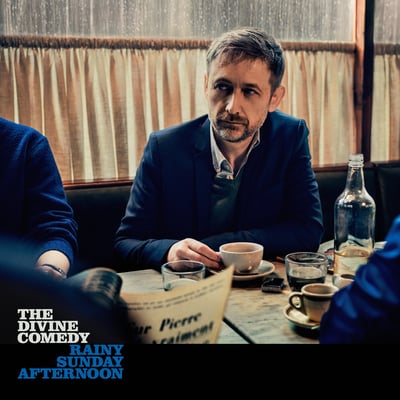
The Divine Comedy Rainy Sunday Afternoon
Released Sep 19, 2025 Divine Comedy Records
Consensus forming 4 professional reviews Updated Oct 1, 2026
Strong critical consensus
Consensus is still forming across 4 professional reviews. The Divine Comedy's Rainy Sunday Afternoon opens like a stained-glass confession: ornate orchestration and sharp satire fold into songs about memory, loss and tiny political observations.
How ChoruScore worksCritics' Top Tracks
The songs critics returned to most
I Want You
3 critic mentions
“I Want You’ has the scope and scale of some of the most gigantic moments from 1997’s ‘A Short Album About Love” — Clash Music
The Last Time I Saw the Old Man
2 critic mentions
“The Last Time I Saw The Old Man’ is, exactly as you might expect, a reflection on the loss of a parent” — Clash Music
Rainy Sunday Afternoon
3 critic mentions
“The former reflects on a lockdown disagreement... winding down to a tender, wistful moment of realisation.” — Clash Music
Full critic consensus
The Divine Comedy's Rainy Sunday Afternoon opens like a stained-glass confession: ornate orchestration and sharp satire fold into songs about memory, loss and tiny political observations. Across four professional reviews the record earned an 85/100 consensus score, and critics repeatedly point to a handful of standout tracks that make the case for its melancholic grandeur.
Critics consistently praise the theatrical craftsmanship on “I Want You”, “Rainy Sunday Afternoon” and “Achilles” as the album's emotional poles, with multiple reviewers naming “I Want You” a darkly potent highlight. Mojo and Hot Press single out “The Last Time I Saw the Old Man” for its Scott Walker-like sweep, while Clash Music elevates “All the Pretty Lights” and closer “Invisible Thread” for their kaleidoscopic takes on nostalgia and memory. Across the reviews the dominant themes - orchestral pop craftsmanship, melancholy threaded with whimsy, and political critique folded into personal reflection - keep returning, giving the collection a cinematic, elegiac arc.
While some critiques note a deliberate clearing-of-the-decks approach, reviewers agree the record's mixtures of childlike fable and mortality feel purposeful rather than indulgent. The critical consensus suggests that Rainy Sunday Afternoon ranks among The Divine Comedy's most richly arranged, emotionally exact work in recent years. For those wondering whether Rainy Sunday Afternoon is worth listening to, the professional reviews point to distinct standout songs and a cohesive thematic core that reward repeated plays.
Track Ratings
How critics rated each track, relative to this album (0-100). Only tracks that made critics feel something are rated.
Achilles
The Last Time I Saw the Old Man
The Man who Turned Into a Chair
I Want You
Rainy Sunday Afternoon
All the Pretty Lights
Down the Rabbit Hole
Mar-a-Lago by the Sea
The Heart is a Lonely Hunter
Can't Let Go
Invisible Thread
Get the next albums worth your time.
Critic-backed picks in one clean digest. No clutter.
What Critics Are Saying
Deep insights from 4 critics who reviewed this album
mu

Critic's Take
The Divine Comedy has rarely sounded so quietly devastating as on Rainy Sunday Afternoon, where the best songs - particularly “All The Pretty Lights” and “Invisible Thread” - find Hannon leaning into memory and longing with orchestral sweep. The reviewer's voice lingers on the bewitching centrepiece “All The Pretty Lights”, calling it a kaleidoscope trawl through pop history that questions cherished childhood memories. There is equal praise for the album closer “Invisible Thread”, described as a truly beautiful track that pairs ache with a luscious chorus. Together these tracks exemplify why Clash judges this one of The Divine Comedy's finest records, balancing emotional wallow with deft arrangments and subtle textures.
Key Points
-
The best song is “All The Pretty Lights” because it is called the bewitching centrepiece that interrogates memory with orchestral sweep.
-
The album’s core strengths are its deft arrangements, emotional nuance and the balance of melancholy within upbeat melodies.
Themes
Ho
Critic's Take
The Divine Comedy's Rainy Sunday Afternoon is stitched together with orchestral pop gems and slyly macabre wit, and the best songs on Rainy Sunday Afternoon prove it. “I Want You” stands out as a delightful rumination on desire, all jaunty strings and sharp observation. The title track, “Rainy Sunday Afternoon”, feels like a small state-of-the-nation address, while “Down the Rabbit Hole” supplies the album's dreamier, illogical counterpoint.
Key Points
-
“I Want You” is the standout for its orchestral pop craftsmanship and witty lyricism.
-
The album's strengths are orchestral arrangements, lyrical wit, and a preoccupation with mortality rendered charmingly.
Themes

Critic's Take
The Divine Comedy's Rainy Sunday Afternoon feels like Neil Hannon clearing the decks, and the best songs - notably “The Last Time I Saw The Old Man” and “I Want You” - are where that orchestral pop melancholy pays off. McNair writes with affectionate precision, calling the title a record of "beautiful melancholy" while singling out the ornate, Scott Walker -ish grandeur of “The Last Time I Saw The Old Man” as a centerpiece. He frames “I Want You” as a "darkly potent portrait," which is why listeners searching for the best tracks on Rainy Sunday Afternoon should start there. The album's mix of childlike fable and profound personal material makes those standout songs feel built to last.
Key Points
-
The Last Time I Saw The Old Man is the best track for its ornate, Scott Walker -ish grandeur and personal subject matter.
-
The album's core strengths are its orchestral pop arrangements, melancholic tone, and a balance of whimsical fable and heartfelt personal songs.